For years I had been patiently waiting for the facilities I instruct in to upgrade their bikes to use power. When these upgrades finally started to happen I was surprised by the different wattage readings I would see, not only, from different brands of bikes but by bikes built by the same manufacturer. I had always assumed a watt is a watt the same way a MPH is MPH or an RPM is an RPM. At first this was VERY disappointing, I have a very technical teaching style and I was hoping to have all my class participants perform a Functional Threshold Power (FTP) Test every 6-8 weeks, calculate their personal power zones and coach each and every class to those zones. Unfortunately, if every bike in the studio reads wattage, even a little bit, differently I would need to adjust my teaching style.
[wlm_private ‘PRO-Platinum|PRO-Monthly|PRO-Gratis|PRO-Seasonal|Platinum-trial|Monthly-trial|PRO-Military|30-Days-of-PRO|90 Day PRO|Stages-Instructor|Schwinn-Instructor|Instructor-Bonus|28 Day Challenge']
I needed to figure out a way to use this new technology, even with it's faults, effectively to give my participants the best workout possible. I decided that the FTP test was still going to be an integral part of my programming and I would still perform this test every 6-8 weeks. I asked my class participants to find 2-3 bikes that they believe are similar in wattage readings and ride those bikes as often as possible. Small differences are ok, large ones make zone training impossible. I also needed a technique to “dial in” new riders, those who never performed the FTP and others who may be forced to ride an unfamiliar bike. I decided to start every class with a proper warm followed by a mini threshold test that I call a “Threshold Check”. This “Threshold Check” can last anywhere between 4-6 minutes and I ask class participants to ride at their maximum sustainable intensity or wattage for the duration of this short test. If the bikes are equipped with a console that will show average wattage I ask for the class to find their average wattage for this “Check”. If the bikes do not have a way of reading average wattage I ask the class to be aware of their wattage throughout the “Check” and choose a wattage that they believe is closest to their maximum sustainable wattage. If I'm teaching on a bike that is not equipped with a power meter I still perform this “threshold check” and i do my best to “anchor” effort with threshold RPE. I also like to “anchor” effort and RPE during the FTP . Most FTP tests last 20 minutes, so 10 minutes into a FTP effort I'll explain that the feelings participants are experiencing, slight breathlessness. burning sensation in the legs and the need to stay extremely focused or wattage will drop is how a threshold effort “feels” and I ask them to associate this feeling with whatever RPE number is used as threshold in the facility I'm teaching in.
Now that each participant has a threshold wattage or RPE to work with I break my profiles down into 3 zones: Above Threshold, Around Threshold and Below Threshold. Efforts that are Above Threshold (greater than 106% of threshold) can last up to 8 minutes, efforts around threshold (90-105% of threshold) can last up to 30 minutes and below threshold efforts (less than 90% of threshold) can last up to 3 hours.
Check out the recorded classes below to hear how I use this “Threshold Check” in a class setting.
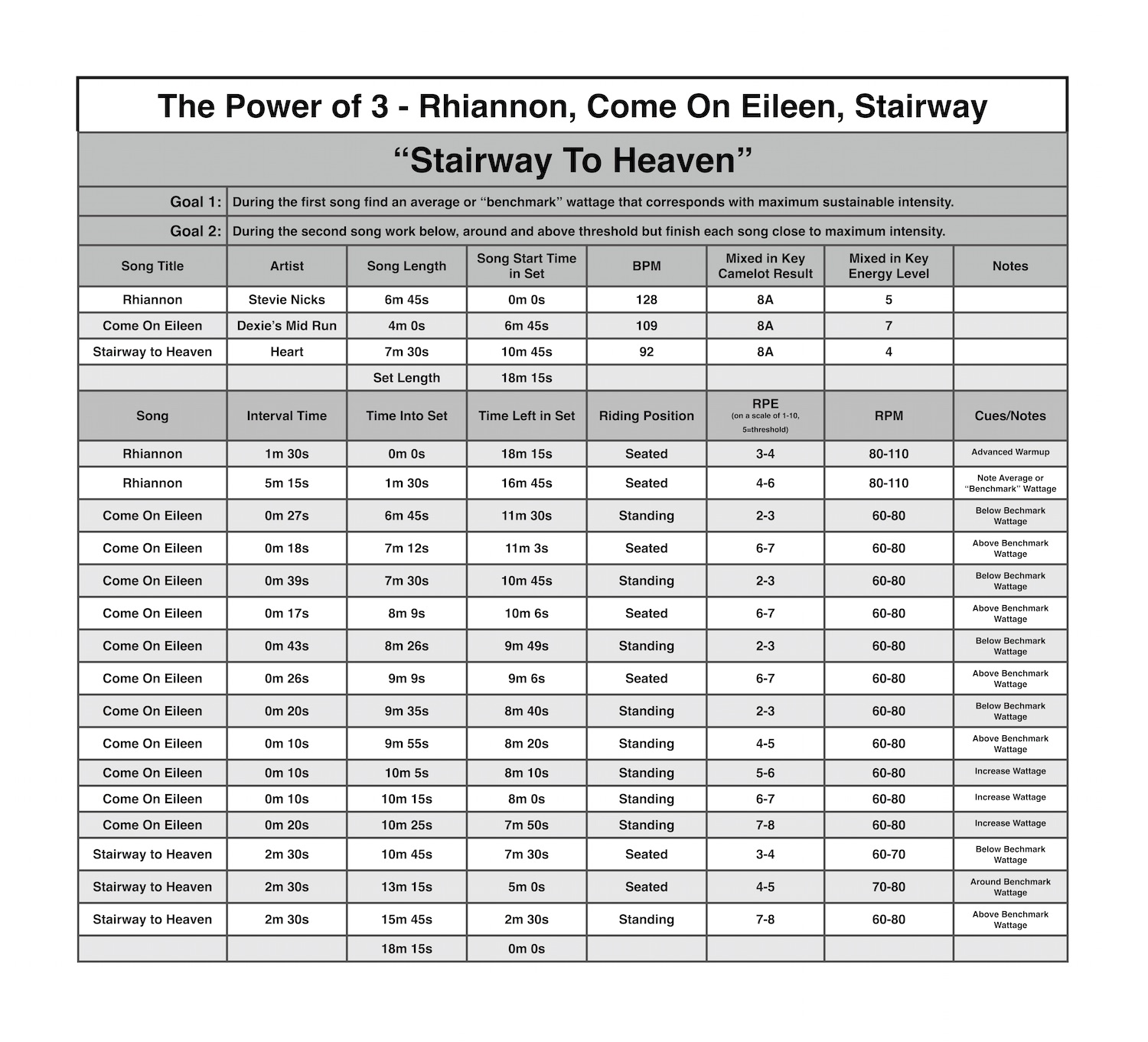
3 song harmonically mixed track, to download Right Click > Save As / Save Target As to download. Open in iTunes and then you'll see this in your Spotify Local File folder.
Here's a great deal for anyone who's been dragging their feet on subscribing to Spotify. Sign up now and get three months for $0.99 – this is for USA customers, you'll need to check to see if the offer is available in your country.
If you're concerned about learning the in's and out's of Spotify – we've got you covered here at ICI/PRO.
Beyond the access to millions of tracks – one of the main benefits of Spotify is how easy it is to share playlists between friends. As an ICI/PRO member you're considered a friend and we have over 60 fabulous playlists that you can download here.
Looking for that perfect track? We have 8 collaborative playlists where you can find song selections from other ICI/PRO members and you can add your own.
Are you forever in search of songs that are motivating, fun and somewhat familiar (but not necessarily Top 40)?
I am too! I like tunes with built in ‘chant' like choruses that we can sing along to.
This week I present to you a band of siblings from Australia (really want to visit there someday) with a 75 rpm, 3:38 minute kickin' song I've been using 12 minutes into class to determine PTP. My class has been singing along and there's even a shout out every now and again as we work to our highest sustainable power.
If clients could meaningfully impact ingrained eating behavior by subtly fine- tuning their thinking patterns about exercise, would you try to help them do that? Consider these new findings from the Cornell Food and Brand Lab as an opportunity to move people in the right direction.
Research published recently in Marketing Letters showed that if participants thought of exercise as “fun” or a “well-deserved break,” versus a “workout,” it significantly changed the way they approached postactivity food consumption. Those with fun top of mind ate less than those who viewed exercise as a workout.
Abstract:
Do consumers eat more when they exercise more? If so, the implications could ripple through the multi-billion dollar fitness and food industries and have implications for both consumers and health-care providers. Three studies–two field experiments and one observational field study–triangulate on this potential compensatory mechanism between physical activity and food intake.
The findings showed that when physical activity was perceived as fun (e.g., when it is labeled as a scenic walk rather than an exercise walk), people subsequently consume less dessert at mealtime and consume fewer hedonic snacks. A final observational field study during a competitive race showed that the more fun people rated the race as being, the less likely they were to compensate with a hedonic snack afterwards. Engaging in a physical activity seems to trigger the search for reward when individuals perceive it as exercise but not when they perceive it as fun. Key implications for the fitness industry and for health-care professionals are detailed along with the simple advice to consumers to make certain they make their physical activity routine fun in order to avoid compensation.
I had to look up the word hedonic to be sure I understood what they meant by; consume fewer hedonic snacks. According to this online dictionary:
What I think they are referring to here is eating as a pleasurable reward, as in; I worked out today… so now I can treat myself to carmel roll/large vanilla latte, candy bar, etc…
All of us in the USA heard (or said) this last week during Thanksgiving – we're doing a “pre-burn” ride or “I'm doing the Turkey Trot Thursday morning”. The purpose of both is to give permission to indulge in hedonic eating, post workout. Problem is that even riding a hard, hour-long class will only consume maybe 300 – 800 calories. One small slice of pumpkin pie has around 300+ calories and that's without whipped cream.
So are we undermining our participants weight loss goals, with all of the metrics we offer?
Have you heard about stomach hunger versus mouth hunger? Many nutritionists and dietitians talk about this. A client mentions eating Something Bad, and the practitioner asks, “Was it stomach hunger or mouth hunger?”
A variation on the question is, “Was it physical hunger or emotional hunger?”
Peak-performance motivator Anthony Robbins says, “If you ask bad questions, you get bad answers.” Asking a client whether she ate because of stomach or mouth hunger — or because of physical versus emotional hunger — is the classic Bad Question.
And it gets bad answers. Answers like “I don’t know” or “I’m not sure.” Sometimes the answer is another bad question: “How can I tell?” The client is trying to figure out if she was hungry for physical reasons or emotional ones.
Despite these rampant failures, the question persists. One book even uses the term “intestinal hunger.” Does anyone out there have any idea what that is? If I can’t understand it, what chance do my clients have?
Of course, if you’re not comfortable handling your participants’ food and eating issues, by all means refer to a nutritionist. This post is about awareness of what some of your participants may go through daily.
A Better Question
Here’s an idea that might be good for practitioners to adopt. I never use the term “hunger” for anything but physical hunger. Instead I ask, “Were you physically hungry, or did you just have an urge to eat?”
That question gets real answers and can uncover some important issues. People can tell the difference.
The urge to eat could have much behind it — emotions, stress, shifts in brain chemistry, shifts in hormones. Some clients might need coaching to explore the emotional component and retrain their responses not to involve food. Some may need to change their diets to change brain chem and/or hormones.
Real Hunger
Hunger is a specific, physical signal that the body needs food. I’ve explained in detail what hunger feels like to clients who don’t experience it.
Why don’t those clients experience hunger?
Some may not because, for years, they’ve been eating for reasons that have nothing to do with hunger:
– the clock says it’s mealtime
– everyone else is eating
– appetizing food is here now
– they ate too much at the last meal
– they’re stressed, depressed, anxious, or even happy.
Readers may conclude that the items in the last bullet show “emotional hunger,” but I’m suggesting that the word “hunger” causes the confusion. It’s more appropriate to use it only when physical hunger signals are present.
How Do I Know If I’m Hungry?
Clients who never feel hungry may be confused about how to determine hunger. If someone says, “I ate breakfast at 7 am, and now it’s 12:30, so I must be hungry,” that’s a thought process, not hunger. The best tactic is to help clients retrain their recognition of hunger through increased awareness of body signals.
It’s helpful to stay aware of misinterpreted signals. An obese client told me his hunger was “here” and placed his hand on his throat. Further questioning revealed that he actually had GERD (gastro-esophageal reflux disorder), which we alleviated in two ways. One was monitoring his work position after eating (he sometimes worked from home in bed). The other was taking an OTC remedy before the meal. (Don’t worry; I checked with his doctor.)
Clients who eat lots of sugar may not experience hunger. Despite research, I haven’t yet found a satisfactory explanation for that. Client symptoms, however, can typically be traced back to drops in glucose. If someone says, “I don’t get hungry, I get a headache,” that could be one sign of reactive hypoglycemia. Other examples exist.
So the absence of hunger could reflect lack of awareness, chronic overeating, or chronically high sugar consumption. When I uncover a solid explanation for the last, I’ll definitely let you know.
In the meantime, if you refer your participants to a nutritionist, please screen them and find one who doesn’t ask about mouth hunger.
This has to be the hardest Indoor Cycling video of all time – ride along on the 13 incredibly steep climbs that make up this annual event on the Saturday after Thanksgiving. I like to coach riders to climb each of these hills using a different cadence > but always above the PTP we will establish during the first climb. Crazy fun!
You can purchase the video or you can suffer with everyone in real time by watching the live event. From their press release:
The Pittsburgh Dirty Dozen will be broadcasted live over the internet from start to finish. This cycling race, over the steepest 13 hills in Pittsburgh, will take place on November 29, 2014 at 10:00am with interviews in the staging area beginning at 9:30am.