I'll bet somebody at Apple/iTunes is getting an ear-full this morning…
SoulCycle sent out an email this morning, announcing their new iPhone App. The email included this link to their App in the iTunes store… which of course opens in iTunes so you can download the software.
Except most people (like me) don't use iTunes to install an App. We download and install Apps directly from our phones.
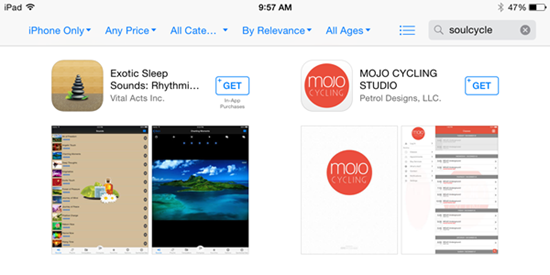
Which is great as long as the App Store can find SoulCycle's App when a user (in this case me) searches for SoulCycle… which returns two available Apps, neither is the SoulCycle App 🙁
So I guess I'll have to go old-school and transfer it from my computer, before I can review it!
413 Update – I'm now seeing you can search and find this now in the App Store using your iPhone.
ICI/PRO contributor and future studio owner Callie Bowling Kelly responded with…
Hey John!
Here's my reply:
This is a fantastic question! If I may pull from my background in Psychology to get to the root of what may be occurring… this sounds like a case of Blockage to me. Blockage from trusting your unique genius to come through and guide you. You know what made you fall in love with indoor cycling, if you didn't you never would have gotten certified to teach in the first place, right!? Get back in touch with what it was that you loved most about cycle classes, and then re-create that passion in your own class.
There is no right or wrong way to set up a class… honestly! The industry is evolving so much that all sorts of studios and instructors are coming up with their own way and re-inventing the wheel so fast my head is spinning (pun intended). I give you complete permission to do whatever it is that feels fun and challenging to YOU and then implement that in your classroom, as long as it's safe of course!
I know all too well the pressure of being up in the front of the room, positioning yourself as a leader, and feeling like you have to perform. It is human nature to want acceptance. We crave it. But, wanting acceptance too badly can literally shut you down artistically, because you second guess every decision you make. We think: how is this going to be received, are they going to like my music, is my class hard enough, what if they think I don't know what I'm doing? All of those thoughts are counterproductive to getting up there and having a great time and inviting your class participants to do the same.
Here's a tip of mine on music and choreography for the ride: I pick EPIC music that has a beat and makes me want to move! For the choreography… I like to work intervals, so in my classes we go hard during the chorus and bridge and recover during the verses. It makes the workout follow the energy of the music which creates pure exercise magic in the class!
Hope that helps John!
Callie
You'll find Callie's fun and informative articles and interviews here.
Lena Hershey is a Spinning® Instructor & Fitness Blogger @ leanlena.com. She offer these practical tips that I feel are perfect for a new Instructor.
Hi John.
Thank you for including me into this. Here's what works for me:
1. Profile first – think “terrain”. Where are your wheels taking you after warm up? Hills? Fast flats? Off the road and through the mud? Lay it out on paper – draw! That really helps me visualize and make the class profile realistic and my cues to class “spot on” not just pure technical.
2. Put your profile onto music. Beware of the lyrics – just as it can be incredibly inspiring, it can ruin a perfectly wonderful intent. Listen carefully to the lyrics of the songs and make sure not just the musical but verbal message matches the purpose you're putting this piece in your class for. Too overwhelming? Go instrumental! Sometimes a non-verbal message of the music can be more powerful than verbal.
3. Ride it. There is nothing wrong in practicing your rides before teaching them – especially when you're new to teaching. It is not a sign of weakness and seasoned instructors do it, too. Get in that room, turn up the music and teach yourself that class you created. Make sure the music flows nicely piece to piece, and practice cueing your ride.
4. If you can't ride it, listen to your class playlist with your drawing in front of you and think of or say what you're going to say in class.
I know how daunting it can be to start putting your class profiles together. Some of them will be worse than others. You will fail before you succeed. Just remember that you're the only one who will notice the “failure” as you're the only one who knows what the plan is. If something doesn't go according to your plan in class, just move on. Your class will follow your lead, so smile and believe in yourself and your profile. Your pack will follow you!
Best regards, Lena Hershey.
Lena and I partnered on the 28 Day Instructor Challenge > what turned out to be a very fun exercise in self development for Instructors, over the course of a month. You can look back the challenge in this series of posts.
The Senior Group Fitness Instructor here Amy, dashed off these thoughts will sitting at the airport.
My quick and dirty response would be:
Categorize music with a beats per minute app on your computer. Climbs = 60 to 80 bpm, Flats = 80 to 100. This helps you ‘hear' the music and what it works best for. Start a playlist called ‘Climbs' and ‘Flats' and add to that playlist as you listen through music….just collect a bunch in each category. This gives you a couple master lists to work from to create classes.
Download ‘Shazam' on your phone. When you're out and about and hear a tune you like, you can ‘Shazam' it and determine the bpm later.
I would highly recommend a Spotify Premium account (approx. $10 a month). That way, you're not paying for individual tunes, but have a huge library and can maintain your lists there.
I label my profiles/playlists primarily by date. I have a small spiral notebook where I write (by hand) the playlist title, each tune, the bpm and time length. I keep this notebook in my gym bag and use it for every class. That way, there's no surprises.
I wasn't sure how to answer this question emailed to me from a new Instructor. So I blasted it out to a bunch of Smart & Talented Instructors I know for their responses.
John:
You and I have exchanged emails before. I am a relatively new instructor (at age 48!)…. Just got my first steady teaching gig (3 classes per week). What I find to be the single biggest challenge as a new instructor is music- music flow, and knowing what drills or activities to do to what music. It is SUPER easy to get a certification…. I am Madd Dogg certified, and will be attending my first WSSC this May. I feel at such a loss though when it comes to setting up a class…. And feel as though I let hours of time evaporate listening to music but not knowing how to incorporate it effectively into what I am doing….
I have a ton of respect for what you do and have been following your facebook page and blog for sometime. I am happy to buy an ICI/pro membership, I am just reluctant at this point to invest in any more resources that I underutilize. Wondering what advice you might have?
Thanks so much for your time!
Irene
Thanks for writing Irene! Here are a few ideas for you…
First from contributor Chris Hawthorne AKA Chrispins – that's a link to her excellent website. You can find all of Chris' informative ICI/PRO articles here)
Hi John,
Happy to help. Here's my answer:
The best way to know what drills or activities to do with your music is to find the BPM (beats per minute) of the songs you would like to use. I use this handy website to help me figure the BPM of new songs : http://www.all8.com/tools/bpm.htm There are also several free apps that will do the same thing.
Once I have the BPM I transfer them into RPM (usually that means dividing by 2). Then I can plug the songs into my profile. Hills are 60-80 RPM's and Flats are 80-110.
Another helpful tip is to keep song folders so that you can easily have the songs you want to ‘plug in' to your profiles. I use Spotify, but you can do this in iTunes as well. You can have folders of songs labeled by BPM, or you can label them with titles such as ‘Warmup', ‘Flats', ‘Hills', ‘Cool Down', etc.
And don't be afraid to use other people's profiles and/or music until you get the hang of it. There a a lot of great instructors sharing their profiles and playlists out there on Facebook, blogs, and sites like ICI/PRO and Pedal-On.
In response to her simple, yet complicated questions. Here is my answer:
The most basic way to address this is to think of your class in two parts.
1. The design of your class
2. The music you will play to fit the design
For me, the design comes first. I decide what I want to do in the class. The warm up is first, and the cool down is last. What goes in between? I teach the “newer vertical” of Indoor Cycling or rhythmic style classes. So for me, “everything in between” is usually a combination of drills that move side to side or front to back, climbs and sprints.
When it comes to listening to music, it should clear right from the first listen, “this is a sprint song” or “this is a climb”. If you have to spend a lot of time deciding what type of song it is, it probably isn't a good song for you to use. Within my iTunes, I create playlists dedicated to different sections of my classes. I have playlists called “Climbs”, “Sprints”, Weights, “Figure 8s”, “Warm Ups”, “Meditations” and “Cool Downs”, for example. When I find a song that fits a category, I add it to the proper playlist.
When building my class, I take the basic design and plug in the songs. This works well for the beginner instructor.
Still having a difficult time? Stop searching for “new” music, and use music that you know and love. Your energy will shine because it's a song that you feel comfortable playing vs. looking crazy because you are trying to make a song that you don't know “fit or work”.
Cassie
Cassie is also a Social Media expert – she offers her ideas on tracking the success of your social media campaigns in this episode of the podcast.
I teach either performance-oriented timed interval rides or visualization rides. In the first case, I pick music to accompany the intervals based on rhythm (appropriate cadence, level of aggression) and length. It is definitely simplest to have intervals of fixed length and layer songs on top which motivate riders.
But visualization rides require helping your participant engage with the course. I ride my bike outdoors year-round and I base my visualization rides on routes I've been on. I tend to turn to my own feelings during those rides. Over rolling hills on a beautiful day, I can get lost in a smooth electronic track with a steady beat. On sharp, punchy climbs with the wind in my face, I need the hook from an aggressive rap track or a wailing guitar from a punk rock song. From my outdoor experiences, knowing there are multiple climbs or anticipating a hard sprint in a group ride, it is okay for the music to run on a little long, to build up, to create some frantic energy.
To manage musical flow, you have to understand the physical demands of the ride. If it's going to be a long, hard ride with little rest, don't be afraid to keep things aggressive – but remember to lighten up at the end of an effort. Every climb eventually ends, every sprint has a finish line, and, at some point, you can always choose to turn out of the wind. Your music should do the same.
Dunte and I had a fun conversation here where you can hear why I instantly added him to the Smart & Talented list 🙂
I've got a bunch more responses that you'll find here. But before you go… how would you have responded?
The Natural Eating Cycle is simple and straightforward: We feel hungry. We eat in response. The hunger stops. We stop eating and lose interest in food.
We could visualize those 4 steps as a circle because they form a continual, ongoing process. Eating that natural way is primal and elemental.
Babies are expert at it, although it obviously takes a parent or caretaker to feed them. The last step is one they have down cold, though. Have you ever tried to feed a baby who’s not hungry anymore? Good luck.
That’s how it’s supposed to be.[wlm_private ‘PRO-Platinum|PRO-Monthly|PRO-Gratis|PRO-Seasonal|Platinum-trial|Monthly-trial|PRO-Military|30-Days-of-PRO|90 Day PRO|Stages-Instructor|Schwinn-Instructor|Instructor-Bonus|28 Day Challenge']
Yet the natural eating cycle can go wrong, and sugar is one reason that can happen. More about sugar’s effects later.
Unnatural eating patterns could include restriction (dieting or fasting); bingeing; purging (self-induced vomiting, abuse of laxatives, excessive exercise); irregular meal timing (skipping meals, grazing all day); extremely rapid eating; or eating a lot of food when not hungry.
I once read 2 different articles, each describing a “disturbed” eating cycle. According to the first cycle, an event disturbs our equilibrium. We eat. We feel fat and resolve to diet.
The other eating cycle went like this: We diet. We feel deprived. We binge.
No doubt some of your students have experienced one or both of those cycles. What if we put the two patterns together and look at interactions among the steps?
1. An event disturbs our equilibrium.
2. We eat.
3. We feel fat and resolve to diet.
4. We diet.
5. We feel deprived.
6. We binge.
The 6 steps in sequence seem reasonable, and form a pattern to which your students might relate. Based on clinical experience, though, I say there’s more to it. Below are a few ways it might go.
Scenario A
We go all the way through steps 1-6. After we binge in Step 6, we then circle back to Step 3 — we feel fat and resolve to diet. From there, we continue through the lower part of the list, and cycle through Steps 3-6, possibly over and over.
Scenario B
We’ve binged, presumably after Steps 1-5. That takes us to Step 1 at the top of the list: bingeing is the event that disturbs our equilibrium, so we eat in response to it. We might then continue to cycle through the remaining Steps 3-6, possibly over and over.
Scenario C
This one involves only Steps 1-3: the event that disturbs us, eating, feeling fat and resolving to diet. But in this scenario, resolving to diet — just anticipating the stress of dieting and deprivation — is enough to disturb our equilibrium, so we eat. Someone could stay stuck in Steps 1-3 in this way for quite some time.
How can sugar make any or all of these 3 scenarios more likely?
We might feel deprived in Step 5 because we gave up sugar to diet and are now experiencing sugar cravings.
We might feel stressed at the anticipation of dieting in Step 3 because it will mean giving up sugar.
With sugar, we might find ourselves at Step 1 more frequently, feeling more disturbed by a greater number of events. That could simply be because the neurochemical effects of sugar make it difficult for some people to maintain equilibrium. Almost any stage of sugar addiction, including withdrawal, can make our behavior (eating behaviors and others) more impulsive.
The natural eating cycle is a delicate balance. It’s always subject to disruption, but eating sugar can disrupt it a lot more. If you have students who are struggling with unnatural eating patterns, please let them know.[/wlm_private]
The gold standard of benchmark testing in indoor cycling is the FTP (Functional Threshold Power) test. I'm a huge fan of this test and perform it with my classes on a monthly basis. In a perfect world every rider would know their power and/or heart rate thresholds and have personalized training zones that are percentages of these values. We don't live in this perfect world and in any given class there will be many participants who have never performed a FTP test and have no idea how to determine their threshold metrics. I deal with this dilemma by beginning every class with a proper warmup followed by a benchmark interval or set of intervals.
My benchmark interval or set can last anywhere from 5-12 minutes depending on the type of class and length of intervals being performed that day. For example if I'm teaching an “@” threshold class with longer intervals I'll do a longer benchmark interval set but if I'm teaching an Above Threshold class I'll do a shorter benchmark interval. These sets or intervals should be be performed at the same intensity that is expected for the main sets of the class and an average HR or wattage should be determined and used as a guide for future intervals in that day’s workout. It is important to cue how the benchmark interval should “feel” especially for new riders who may not have previous rides to base their HR or wattage numbers on.
[wlm_private ‘PRO-Platinum|PRO-Monthly|PRO-Gratis|PRO-Seasonal|Platinum-trial|Monthly-trial|PRO-Military|30-Days-of-PRO|90 Day PRO|Stages-Instructor|Schwinn-Instructor|Instructor-Bonus|28 Day Challenge']
Now that each rider has a metric to aim for during each interval or set the instructor can set realistic and attainable goals.
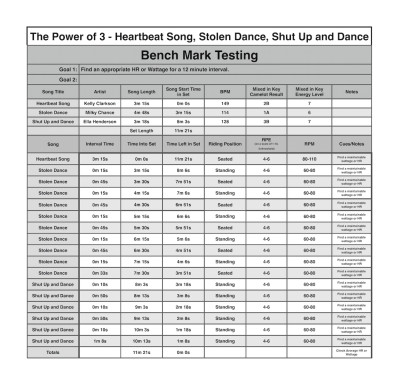
3 song harmonically mixed track, to download Right Click > Save As / Save Target As to download. Open in iTunes and then you'll see this in your Spotify Local File folder.
Life Time Fitness is hiring! If you've always wanted to teach Indoor Cycling or Group Fitness, at one of their 100+ beautiful upper-end big box clubs, this is could be your big chance 🙂
They (LTF) are all about member experience. The equipment (awesome sound system/twin big-screens for video + FreeMotion S11.9 Indoor Cycles with power) and their studios are fantastic. Their pay is respectable and you aren't forced to use music that's provided for you like at LA Fitness.
What should you do?
First, so you know, I know LTF 🙂 I'm lucky to live smack dab in the middle of four Life Time locations – with regularly scheduled Indoor Cycling classes with them since 2008.
#1 Read through these articles. We've helped dozens of Instructors get hired by Life Time
Our Mission is to provide an Educational, Entertaining, Friendly and Inviting, Functional and Innovative experience of uncompromising quality that meets the health and fitness needs of the entire family.
Don't take knowing this mission statement lightly – it's not optional. YOU WILL BE ASKED TO RECITE IT AS PART OF ANY AUDITION.
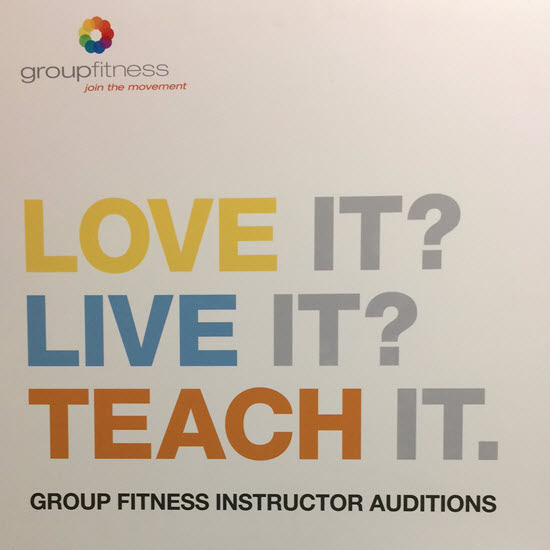
#3 Go to your local club location and find the the sign that looks like the image at the top of this page. It will include information about the audition schedule, name of the Dept Head running the auditions, etc…
NOTE: Some locations might not have immediate openings, but I wouldn't let that stop you from attending and showing your stuff!
#4 I'm big on taking bold action, so I'd recommend finding a way to meet with the Group Fitness Dept Head, before the audition day, in person > if at all possible. You might ask the front desk if he/she is available right now.
If yes, then introduce yourself and expressing your enthusiasm for being part of her/his Instructor team. Ask an open ended question like; “what can I do to prepare for the audition?” and then listen. Now isn't the time to sell yourself… unless you are asked a specific question. Be respectful of their time and say so; “I know you're a very busy person, my objective to let you know who I am and that I'm very excited for the audition on ___________ and look forward to seeing you again then.
That's it, unless she/he appears to have more time for you. Be very careful not to ask anything beyond advice.
If no, ask when would be the best time to call and what number. They work crazy hours, so I'd call at different times until they answer – I wouldn't suggest leaving a message or emailing. Call until you get through. Tell them about your interest in teaching for them (again, NO SELLING) and then ask if you could meet them for two minutes to introduce yourself in person. Give two very specific days & times – DO NOT ASK; “what would be a good time to meet?” Busy people hate it when they're asked that… but they love when you give them a solid time that they can easily say yes/no to. Then follow the above.
No worries > they'll train you! Life Time realises that they need to develop/train people passionate about fitness, to become Instructors, through their Life Time Academy.
Group Fitness Instructor Training Overview
The Life Time Academy Professional Fitness Specialist program provides a unique educational experience of on-line, in classroom and hands-on learning, integrated with practical experiences that prepare graduates to succeed as a Professional Fitness Specialist in their respective area of emphasis.
The emphasis of the Group Fitness Instructor Program provides a quality educational experience that prepares graduates to succeed in the area of group fitness instruction, whether they are new to the industry or expanding their skills.
Topics covered in the Life Time Academy Group Fitness Instructor Training (GFIT) 50-hour program meet or exceed all the required standards set forth by the American Council on Exercise to achieve certification as well as the practical skills to lead a best-in-class group fitness experience.
With an 8-week curriculum, totaling 50 contact hours, the instructor-led coursework consists of approximately 30 hours of online study (reading, videos, activities, assignments and quizzes), 16 hours of in-club lab class time and 4 hours of practicum.
Curriculum includes:
Exercise Science Foundations
Essentials of Group Fitness
If you don't have a certification, I would ask the GFDH during your intro meeting for their advice for getting your training. LTF has multiple workshops throughout the year where you can receive the training you need.
Good luck and let me know when you're successfully on the schedule!