
by Christine Nielsen | Oct 28, 2020 | Engage Your Students
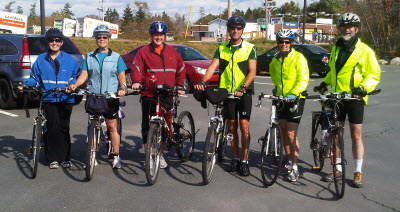
When a friend and I returned from a cycling trip in Croatia last June my IC classes were curious about the experience and I told them lots of stories. One day I mused “Now that we have done some hills in Europe I guess it’s time to do the hills here at home. We’ll be riding the Cabot Trail next.” http://www.mapmyride.com/s/routes/view/bike-ride-map/canada/nova-scotia/cape-breton/8895784
Follow that link to see just how big a challenge this will be 🙂
Within minutes the class had come up with a scheme to ride the trail as a group. Word of our plans has spread and new people have arrived in my classes to be part of this adventure. Most of them have never done any serious riding outdoors and several do not even own bicycles. We are aiming for a four to six day trip in late September 2012. Right now we are making plans for winter training and a spring reconnaissance ride for the ‘leaders’.
Yesterday, with temperatures in the mid-teens (℃) and under a sunny sky, a few of the group got together for their first ride. We did a safety check on the bikes and headed out with the promise that no one would be left behind. I placed experienced riders at lead and sweep and had a spare to accompany anyone who turned back. The most ambitious riders did 28 kilometers and realized after the fact that they could have done more. I was very supportive of their decision to ride within themselves. It will be time to test their limits after they have improved their form and bike handling skills.
Next time we do this route I will encourage them to do a 52 kilometer loop. They will all be amazed at how much farther and faster they will travel than they did on their first outing.
In anticipation of this weekend, I put together a profile for my classes which simulated parts of the ride and, in particular, highlighted how to avoid red-lining on the hills. Several people told me that they relied on that information when they found themselves in doubt during yesterday's efforts. As proof that they find real-time data useful — every one but me had on their heart rate monitor! I had an opportunity to ride with and coach each member of the group. One person stood out for me – her ability to receive verbal guidance and apply it was outstanding. Her skills improved dramatically and she was rewarded by being able to ride a hill she had had to walk on the way out. Another rider surprised us all – she was very strong even though she had previously only ridden on rail trails. She attributed her performance to her indoor experiences – improved endurance and better form.
Next up: a clinic on gears and shifting and a discussion about bike choice. Most of the group will be purchasing a new or new-to-them bike in the next few months.
Originally posted 2011-10-20 05:11:38.
by Christine Nielsen | Aug 12, 2017 | Engage Your Students, Learn Leadership Skills

OK [wlm_firstname], What's holding you back?
I had an ‘aha' moment after last week's Sunday morning ride with the group which is going to tackle the Cabot Trail. All of these people started their cycling in my indoor classes so I have had an opportunity to observe their strengths and limitations. I can work on the same issues indoors and then outdoors, and then take the outdoors experience indoors to help people bring greater refinement to their form and understanding of their bodies.
About a year ago a 50ish year old woman arrived in my class. My questions about other physical activity revealed that she did a lot of Pilates. That was clear from the moment she got on the bike – good core and balance. On the other hand, she didn't seem familiar with the sensations of cardiovascular exercise. Over the next few weeks I had an opportunity to teach her the value of a a heart rate monitor. I saw a gradual change in her willingness to work hard. Her greatest limitation became her seeming inability to raise her cadence, even a little bit, under any circumstances.
Fast forward to this year. Her cadence indoors has increased dramatically but as soon as she got on a bike outdoors she reverted. I knew that she was well-prepared in terms of fitness and strength so that wasn't the reason for the change. I spent a lot of time riding with her or leaving her to the sweep with specific instructions for coaching. She was consistently the slowest rider but never complained and didn't seem discouraged about her progress. This seemed odd. In her ‘real' life she is an accomplished and driven university administrator.
I struggled to identify what I could do to help her. Two weeks ago I rode with her and observed that when road conditions would allow her to speed up she didn't. Speed was not the problem – she is a confident and fast descender. I began to give her speed checks, encouraging her to find the sweet spot that would let her move a little faster with a high cadence while keeping her effort in check. Halfway through that day I left her with the sweep and rode on to work with other riders. When I checked the sweep's GPS the next day, I noticed that Michelle's average speed was painfully slow even though that part of the route was not challenging.
Last Sunday I saw that Michelle had purchased a bike computer. She reported that the speed checks I had given her were very instructive. At that point I asked her how fast she was going at the end of the previous week. Her response was a number that was more than twice the actual. She was genuinely shocked when I told her what I had seen on the GPS record. Michelle had a great ride that day, with an average speed about twice what it has been. She finished only five minutes behind the biggest part of the group.
Over lunch after the ride she told us a story. As a girl of ten, she had an asthma attack while playing outside and was hospitalized. Her asthma disappeared shortly after but the effect on her behavior did not. The process of training for the trail helped her to recognize that she has been holding back ever since that first attack. Once she allowed herself to let go of the fear, the skills and knowledge she has acquired both indoors and outdoors let her perform to her potential.
As a coach I had my own epiphany that day. I realized that everyone has a story like that. Mine dates back to a second grade teacher who told me I couldn't draw. I didn't put pencil to paper for four decades. Now I make a part of my living as an artist. Recognizing that we all have a similar ‘story' will encourage me to keep gently exploring around the edges, reinforcing progress when I see it and keeping my students aware of the mental aspects of their performance.
Originally posted 2012-08-02 06:42:01.
by Christine Nielsen | May 7, 2017 | Date Specific, Engage Your Students, Instructor Training

We are less than 60 days from our ride around the Cabot Trail. The group has been very active – increasing distance to 55 km for morning rides, grades to 7+% for hill repeats and making lots of connections between the indoor and outdoor efforts in my classes.
We closed the opportunity to join us last week so that we’d have a consistent group with whom to train over the next two months. Twelve people will ride the Trail. At a maximum we had 17 people on one of our Sunday training rides. As word got out, friends of friends started to attend and we welcomed their interest. They will be invited to re-join us for some weekend jaunts this fall.
Here are some highlights relevant to the indoor/outdoor cycling interface.
We did a quick reconnaissance of the route last weekend and some of the descents are daunting. As I negotiated the road in a car I became painfully aware that no amount of indoor cycling can help people learn how to descend. We have been working on those skills outdoors but can’t reproduce the Trail experience nearby. I have contracted a Can-Bike educator to give the group a lecture and clinic. Meanwhile we’ll content ourselves with the knowledge that less prepared people ride the Trail every year and none of them have ended up in the ocean.
The transformation of individuals from bikers to cyclists is noticeable. I am most thrilled by Judy who panicked and bailed on her first attempt at a road ride last fall. She was the first to buy a new bike this spring, always turns in her training logs and is now one of our strongest riders. Better yet, when the group organizes its own trips during the week, she consistently chooses the one that will give her the greatest challenge. I am writing up an interview with her which I think will interest you as she describes the indoor to outdoor experience.
I teach in a facility with a mixture of non-power and power bikes. That precludes classes which are entirely focussed on power. Recently, though, I have been able to let everyone re-visit their FTP (60 min). The numbers range from 1.4 to 1.9 watts/lb (measured over 20 minutes and corrected for 60 minutes (x .90)) for the group who is doing the Trail. Remember – these were non-exercisers/non-cyclists a few months ago. They have all seen a huge increase in their power over that period. Better yet, their results are completely consistent with what they see in one another on the road. The power info has really helped the weaker riders understand the connection between indoors and outdoors.
You can read my earlier posts about preparing a group of Indoor Cycling students for our trip to ride the Cabot Trail here.
Originally posted 2012-07-04 05:38:16.
by Christine Nielsen | May 7, 2017 | Date Specific, Engage Your Students

It is difficult to explain how iconic the Cabot Trail is to Nova Scotians and even Canadians. With six significant climbs (some of which are 13-17% for long stretches) it is notorious and glorious at the same time. The scenery is unparalleled and there is a mystique about the Highlands which captures everyone's imagination. The trail has been labeled “one of the greatest bike routes on earth” by Bicycling Magazine. Its notoriety has both intrigued and deterred many ‘ordinary’ people from attempting to ride or run it.
There is no doubt that some of the members of our group were initially attracted to our project by the concept of taking the trail and living to tell the story. As their journey has unfolded they have become much more enthusiastic about their own health and skills, and just as we hoped, the Trail is now only a subsidiary goal. Improving their fitness and their cycling skills has become foremost in their minds.
In the last month more people have been drawn into our group. All of them are non-cyclists and some of them have no recent history of exercise. They have been attracted by the experience of family members who are part of our group or by the buzz that has started to build around our trip. I am delighted by the ripple effect of our activities. It will have a lasting impact on individuals and their families and on our small community.
Our Sunday activities over the last few weeks have included:
- a 2.5 hour trail ride
- a 2 hour trail and road ride including some hill instruction
- hill repeats
- road ride – 3 x 13 km loops with moderate traffic, flats and hills to 14%
In addition my husband and I ran a tire/tube/wheel workshop. It was really well attended and went a long way to break down people's fear of their bikes. We'll do another mechanical workshop in a few weeks.
Participants continue to attend two indoor cycling classes per week. They also fit bike rides and strength training into their weeks. Their training logs show that they are planning their activities carefully, with rest days and a month over month increase in training load. The weather is now improving to the point where it will reasonable for us to plan much longer Sunday rides. In the works for the next three weeks:
- an indoor climbing session (we have booked the whole facility for some risk-taking, bonding and laughter)
- a 55 km trail ride broken by brunch (world’s best lobster Eggs Benedict)
- more work on hills
- a 52 km loop road ride, with some significant traffic and two challenging hills
For those of you who are considering doing something similar in your community, next week I will provide a breakdown of the time commitment and activities which have been necessary to organize the Take the Trail project to date.
[plulz_social_like width=”350″ send=”false” font=”arial” action=”like” layout=”standard” faces=”false” ]
Originally posted 2012-05-15 08:12:28.
by Christine Nielsen | Sep 4, 2012 | Engage Your Students, Instructor Training

John –
Here's a short report. They did so well and were giddy with their achievement. I will try to distill my thoughts about the whole project over the next couple of weeks. I really hope I can inspire other instructors to try something similar (but maybe not so ambitious – I couldn't believe how hard I crashed in the couple of hours after it was all over.)
Toss Out Your Elephants
Here's a brief update on our trip. It was marked by laughter, tears, breathtaking views and amazing personal achievement. Everyone made it safely around the Trail. One person had a bike failure that we couldn't resolve so only got to ride for the first day and a half. Two people rode every centimeter of the way. Others found that they eventually had to walk part of a 6 km 11% grade and many of them opted to walk down the 12-13% grade descent. They successfully conquered the other two major climbs.
I rode sweep on the two most challenging days. That allowed me to stay with and support the back markers. It was incredibly affirming to hear them talking about and see them using material they had learned in my classes. It got even better when they started chanting the catchphrases I use to crystallize some of the most important concepts.
Here's my favorite story from the trip. One of our late spring training sessions was structured as a warm-up, a 6% hill (the most they had done to that point), skill development on other hills and a return to the 6% hill to put into practice what they had learned. On both times up the biggest hill one rider really struggled and complained that “A herd of elephants is sitting on my chest.” I know her capacity for work because I see her in my classes 2-3 times per week so doubted that she was experiencing true physical difficulty. We spent the next few weeks talking about the source of the elephants and she finally seemed to accept that they were “in her head”.
On the last day of the Cabot Trail trip I was riding with her on an 8 km section of 7% grade. She and other riders chatted all the way up and were suitably impressed by their ability to do so. When we neared the top I asked her “Do you have any elephants today?” She replied that she had packed up the elephants and put them away. We rode in silence for about a minute. Then she added “No, that's wrong. I didn't pack up the elephants. I tossed them out. I don't need them any more.”
I will write much more after I have had a chance to let the events of the trip and our entire training journey settle into perspective. But I know now that I will treasure forever the opportunity to help toss out some elephants.
