
by Jim Karanas | Oct 30, 2017 | Master Instructor Blog

By Team ICG® Master Trainer Jim Karanas
The demand for our product is there. The market for our product consists largely of club operators. Yet the factors we believe make our product special are no longer clear to our customers.
The product is Indoor Cycling and all of its trappings: brand, bike, service, ancillary products, training, continuing education — everything in a club's indoor cycling program. At ICG®, for example, we believe we have a great product, and I can tell you precisely why. But all directors will tell you the same thing about their product. What I finally realized is that the things I believe make ICG unique are not generally recognized by the market as a whole.
Indoor cycling has become commoditized. A commodity is “a class of goods for which there is a demand that is supplied without qualitative differentiation across a market.” That means the market treats the product as nearly equivalent no matter who produces it.
Club operators know they have to offer indoor cycling to be competitive. Yet many of the factors that matter to us as instructors don’t necessarily matter to others. Cycling movements. The number of hand positions. Cadence ranges. Beat Match vs. Freestyle. RPE, heart rate or power. And my favorite, Q factor.
The market doesn’t care about these things the way we do. Some of these may influence buying decisions from time to time, but they’re often trumped by sales relationships, service and timing. The club operators want to know if they can get a good product at a good cost, if the company will be there when they need help, and if they can get the product as soon as they need it.
Last week, Team ICG® posted an opportunity for ICI-PRO members to access our online continuing education service. It's free. It will save you money and provide you with a service that improves the product you offer (your class) to your customer (your club's indoor cycling director).
Like it or not, our classes are also commoditized. Do you believe that those who hire us as instructors really care which education curriculum we present? Most indoor cycling instructors present a combination of what they’ve learned over the years. The principles we’ve accumulated have become our own. As long as our employer knows we’re certified under a governing body and presenting techniques that keep the members safe, do you really think they see a difference in which name they put on their program?
If you do, you’ll contradict what I’ve written and won’t believe that indoor cycling is a commodity. You’ll still think differences between cycling programs are more important to clubs than sales, service and timing.
Save
by Jim Karanas | Aug 18, 2017 | Instructor Training, Master Instructor Blog, Teaching Intro Classes, Zone based Heart Rate Training

By Team ICG® Master Trainer Jim Karanas
This protocol, developed by Team ICG®, outlines a “first HRM experience” to help the student connect HR with perceived exertion. The last post covered the warm-up and Level 1. From here, the progression builds to greater levels of effort.
Level 2
This is where the student’s sensitivity will grow the most. A novice is least able to feel the subtle changes that occur at this level. Level 2 is the point at which a training effect, i.e., improved functioning of the cardiovascular system after recovery, begins to take place. Level 1 is not intense enough to produce such a fitness effect.
Still maintaining 90 rpm, have the students raise the resistance slightly. At some point, the low muscle load will lead to a combination of rhythmic breathing and light sweating. The sensation of a training effect is quite noticeable to the experienced exerciser. There’s a feeling that continued training at Level 2 would make you stronger. Over time, the practical consequence of the training effect is a reduction in force necessary to apply power, and you can feel this begin to happen at level 2.
This sensation is hard to pin down for beginners. They may notice an amplification of their senses, a tingling throughout their body, or emotions. They may feel more relaxed and peaceful, even though their HR has gone up. They may smile.
In order to improve, musicians practice scales. There’s awareness that practicing scales will make them better musicians, so they don’t mind doing it. That’s the training effect. Level 2 feels like the beginning of practice that you know will bring improvement.
As an instructor, you must spend time at this intensity to recognize and appreciate the sensations fully so that you can accurately describe them to your students. Then relate them to HR. Maintain for 4 minutes.
Level 3
Continuing at 90 rpm, add resistance to raise HR again. There should be an immediate shift in the students’ feeling of effort. It now takes work to maintain 90 rpm. There may be an immediate sensation of difficulty, e.g., burning in the legs and/or breathlessness. This should last no more than one minute, although Level 3 continues past that.
Some students will start to breathe rhythmically and exhale forcibly to mitigate the difficulty. This natural mechanism dispels carbon dioxide and stabilizes blood pH. Demonstrate rhythmic breathing with forceful exhalations and explain that it will alleviate the feeling of difficulty, so they’ll feel better. Have them notice, or even induce, synchronization between their breathing and their cadence.
Have them settle into a new, higher target HR. This HR needs to be at a level that they could hold for about an hour, but with difficulty. “There are a lot of HRs you could hold for an hour, but we’re looking for the highest one you think you could maintain for that length of time.”
This level of effort feels like working out. It’s sustainable for an hour or so and isn’t painful, yet requires rhythmic breathing and focus to maintain comfortably. Maintain it for 4 minutes.
This is a good time to discuss what aerobic really means and how the increased workload has increased the demand for oxygen.
Before this segment is over, let them know what’s going to happen next: you’re going to raise their level of effort to threshold. (You may want to modify some students’ training, depending on fitness.) Threshold, in this case, is the level of effort at which the body’s ability to transport oxygen to the working muscles becomes compromised, resulting in an increase in anaerobic metabolism and a state of continuous discomfort.
My post “Why Do I Have to Hurt?” mentions that we’re not neurologically wired to accept pain willingly. Unless we’re completely conscious of what we’re doing, we’ll unconsciously find some way to offset the work and mitigate the pain. (Reducing cadence is the most typical example.) Let them know that they’re about to go into hurt, and that it’s part of training. If they’re not up for it, have them stay at their present HR.
Level 4
While maintaining the same resistance, have them increase their cadence to 100 rpm. You must use Beatmatch; otherwise, they won’t pedal hard enough. “This time, you’re at a level that you could hold — with difficulty — for about 30, maybe 40, minutes.”
Point out that this should change a number of things in the body: certainly breathing (they may find it difficult to get enough air), body temperature (pouring sweat), even thinking (conflict and doubt). An internal monologue may begin.
Encourage them to maintain focus. There are various names for this level of effort — anaerobic threshold, lactate threshold, ventilatory threshold — and each of them means something slightly different physiologically. For now, we’ll just call it threshold. It is not an exact number and refers to the heart rate below which you can keep exercising for a sustained time (with effort), and above which you tire very quickly. Thirty minutes seems like an eternity.
Have them pick their target HR and maintain it for 4 minutes. It’s easy to recognize this level of effort in a student. No one should seem distracted. Also, a look of true anxiety is difficult to fake.
It needs to hurt right away. The hurt is manageable, but they’re never comfortable. If you were to approach the student and ask how he/she is feeling, the reply would be, “Please get away from me.” (Perception of this level may vary with fitness.)
If they’re doing it right, it’s not a good time to discuss or teach anything. Remind them to stay at their target HR, maintain the increased pedaling speed, and breathe out forcibly in a rhythm. If they can’t maintain 100 rpm, have them adjust their resistance slightly but maintain their target HR.
Level 5
Tell them that it’s now time to peak their HR, to take it as high as they can that day. They need to go above threshold. Add resistance and maintain 100 rpm to raise HR for the final stage. Alternate a 30-second standing jog at ~90 rpm with 30 seconds seated at 100 rpm — but at full effort. The actual standing cadence is less important than the effort, but it must raise their HR. Many students, however, will drop their cadence because they’ve stopped caring about what they’re doing. It hurts too much. So the best cue is to make them jog as fast as they can. The effort is barely manageable and not sustainable for more than a few minutes.
Do this for only 3 minutes. Every time they stand and jog, they attempt to raise the HR higher. Since they’re holding this for 3 minutes, it will be uncomfortable and pretty much about survival. Cadence will keep slipping. They’ll experience failure. Keep them checking their HRMs so they remember their peak HR. Play razor-sharp, acerbic music with a rhythm to which they can Beatmatch when standing. Tell them to stay tough and not give up until you cue it, even if they hit failure.
Recovery
Have them regain composure quickly. After they’ve rolled for a few seconds, have them take off all resistance and bring the spin up to 100 rpm. It should feel easy.
Your students now have a numerical representation to match a perceived awareness of their exercise HR range. They’re likely to have come close to max HR, which can be used to help determine zones, depending on your method.
Training zones can now be related to a perception of effort. This will eliminate ambiguity when it comes to determining the correct level of effort for a designed training.
Have them ride with good form for 10 minutes as they spin their legs. If they start to get cold, have them add a little resistance. Review the various levels of effort (including resting and warm-up) and have them recall both the perception and the approximate HR for each feeling.
Originally posted 2012-10-01 07:56:16.
by Jim Karanas | Aug 1, 2017 | Master Instructor Blog, Mental Toughness
By Team ICG® Master Trainer Jim Karanas
As you may know from reading these posts, I’ve written about motivation in several of them. I’m often asked to speak to groups about motivation, or write about it in newsletters that go out to athletes. It typically happens in January, because the expectation is that everyone has de-tuned over the holiday season and let their fitness and discipline slide. Since I don’t look at motivation or athletic training in that way, there doesn’t seem to be any reason not to write about it in July.
True, motivation probably is a good topic for the first newsletter of a new year, but I still consider it somewhat ludicrous. I’ve read too many articles about “getting started again” or “staying motivated”. In my mind, training never stops. You can be in an ICU after having open-heart surgery to repair a malfunctioning mitral valve with a congenital defect, and still train. You may not be logging miles, but you can train.
Physical training seems to me to be a natural process that incorporates conscious development and the integration of mind, body and emotions. It’s a form of human development that produces greater insight. If you approach your training in this way, it can and will enhance virtually every endeavor you undertake. You may even improve your performance as an athlete. At the very least, you’ll get more and take more (i.e., use more) from the experience.
When you understand this, training becomes an experience that engages you throughout your life regardless of circumstance. If for some reason you can’t train your body, you can still train your mind. If for some reason you can’t focus your mind, you can practice firing your emotions, or stimulating your will, or reducing your anger, or accepting what you are and are capable of doing.
Once you head down that path, there is no more stopping and starting. You may take a physical break, but, if you lose touch with what your training means to you, you’re simply exercising. Not that there’s anything wrong with that. It just has the capacity to be so much more. (See The Tao of Training, Part 1 and Part 2.)
If you tend to take a physical break during the holidays — and that could even include the long Independence Day weekend some may recently have taken — hopefully you feel rejuvenated when you return, rather than “out of it”. If you’re beginning a training cycle, you need to plan your competition phase: which races you will enter and your specific goals for each race. Decide which races are the most demanding and/or the ones in which you wish to perform best.
If you find metrics motivating, it could be worthwhile to find out where to obtain a fitness assessment that you know how to interpret, or that a coach can interpret for you. If not, begin with your base. Keep your training relaxed and comfortable and enjoy this phase.
Re-establish your drive by committing time and energy to understanding the motivation behind your training. If your motivation has not evolved, and you find yourself training for the same reasons you did last year, say hello to a plateau.
Maybe instead of turning your attention to getting back in shape, your first priority should be to determine the reasons you will log more miles — or train with greater commitment — this year.
Then do it because you know exactly why you want to.
Originally posted 2013-07-21 08:19:37.
by Jim Karanas | Jun 1, 2017 | Master Instructor Blog
By Team ICG® Master Trainers Jim Karanas and Joan Kent
Over 12 years ago, Jim developed an athletic training program that eventually earned the tagline “Stop exercising. Start training.” At ICG®, we think there’s a difference between the two, one that people ask about frequently. Training encompasses more than the physical aspect of the ride.
Currently, training versus exercise is a popular topic. An internet search readily reveals the ongoing discussion, with suggestions and ideas as to the difference.
According to some sources, training is based on having a purpose, setting goals and achieving specific results. Exercise, in contrast, has been said to lack focus, goals or purpose. Training is said to be intense and engaging. Exercise is said to lack intensity and even be boring.
But are those really the differences? Say someone wants to lose weight and begins the following process: an indoor cycling class on Monday, an elliptical workout on Tuesday, a kickboxing class on Wednesday, Bikram yoga on Thursday, treadmill running on Friday, and body conditioning on Saturday morning.
Is that exercise or training? There’s a goal/purpose. The activities listed would provide intensity, plus variety to prevent boredom. Yet the weekly plan looks more like random exercise than structured training, so the differences must lie elsewhere.
We think the above distinctions are only part of the difference between training and exercise, and not necessarily the key points.
First, for a workout plan to be training, it probably needs to be progressive. Progressive training might start with foundation-level workouts and move into more intense levels of effort that are also designed to make the participant stronger in the activities. For that to be effective, the activities might need to be limited (say, to indoor cycling and treadmill running), rather than a hodge-podge of many unrelated things. Specific adaptations occur more consistently when the activities are specific, too.
Limiting the activities and following an overall progression wouldn’t preclude changing the format. But changes would be designed to elicit a specific training outcome for each session, rather than simply to prevent boredom, and the student is made aware of that objective.
The progression might culminate in performance events. A lot can be said about athletic performance, and will be in another post, but maximum efforts differ from what could be called “pseudo-hard.” People who love to work hard are typically talking about pseudo-hard efforts, rather than max.
Attitude or mindset is also important. It’s not simply working out to drop a few pounds, but training to develop our consciousness, nourish our body, change and quiet our thoughts, and balance our mind. Let that be the philosophy. Workouts without philosophy lack consciousness. Training is about bringing consciousness into the process. When we focus on what we’re doing and stay highly conscious of all of it, it’s never boring. It’s simply what is.
To maintain presence, we need to recognize the intrusion of thought immediately and bring awareness back to the moment, no past, no future. A sense of self in the moment is the way to turn off the mind. If we project into the future, the mind comes in like a tidal wave and sucks us into a stream of thought. Thoughts create time, make minutes feel like hours, and rob us of the desire to continue.
Then there’s pain. Or more precisely, the approach to it. We’re all familiar with “no pain, no gain” and the attitude that pain — certain types, at least — can be good because it means the workout is beneficial.
There’s also the “Hulk Will Smash” approach: the more it hurts, the more I like it. Grrr. Fanatics with no sense beyond the muscle of exercise may use that to complete their workouts, but addiction to pain isn’t training.
Training is a more mindful approach to pain that involves feeling it, fully understanding it, being sensitive to it — and putting a space around it, becoming nonreactive.
In what we do, pain is inevitable. But it’s just a trigger. It may stimulate resistance that compares to an emotional state. As our emotional threshold rises, our reaction to the pain changes. It doesn't feel any better. It just doesn't bother us as much. The warrior chooses death. Athletes choose physical pain, or at least non-avoidance of pain. As the polarization in our mind diminishes, our emotional reaction to the pain becomes one of acceptance or even dismissal.
Any athlete can recall having had the time of his/her life despite feeling pain during an event. A couple of decades in the fitness industry make it clear that anyone who wonders why an athlete would do something unpleasant, like push through pain to reach a goal, can’t adhere to a fitness program for any length of time.
Tools such as consciousness, presence in the moment, attentiveness, curiosity, non-reactivity, and so on are ultimately ways to add balance. Training tests our effectiveness with them. Exercise lacks these tools.
Originally posted 2012-03-26 09:52:29.
by Jim Karanas | May 26, 2017 | Engage Your Students, Master Instructor Blog
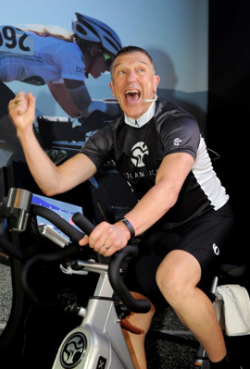
By Team ICG® Master Trainer Jim Karanas
I’ll switch gears from my recent posts on using public speaking techniques to enhance our teaching to talk about what we say. In The Art of Cueing, I discussed the use of cues to bring depth to the class and make it more than just a workout. Cues concerning the science, the music, the video, your personal experience, even philosophy can make your class more interesting and more impactful.
Philosophical cues are the most difficult to incorporate. Instructors don’t typically cover philosophy when they teach because they don’t think people want to hear it, or they don’t feel comfortable talking about it. Someone who doesn’t teach might say the first is true. But maybe that person hasn’t yet heard a well-delivered philosophical message and is just uninformed.
I understand not feeling comfortable talking about it and will address that later.
Adding philosophy to a class so it doesn’t sound like preaching is what I call “messaging.” A class without messaging is just a workout. It might even be a good one. But the instructor’s power will weaken over time, just like playing the same workout video over and over. It diminishes with no message. All the public speaking techniques in the world can’t compensate for a class that lacks substance.
Unforgettable lyrics are unforgettable because they send a message. A public address goes viral on YouTube when it sends a message. Messaging will touch a person’s life beyond the great workout you just delivered and compel him/her to come back to your class again and again.
What’s a message? Any life concept that you bring to the class and that can be experienced in the class as result of the training you’re providing. A couple of examples:
Focus
Coaches often tell you to “stay focused” but rarely tell you how. Focus is not simply directing your attention to what you’re doing. That leads to thinking. Thinking will weaken focus. Focus is complete engagement in what you’re doing. A focused mind pays no attention to distractions. Fast descending takes focus. If you’re not 100% engaged and non-reactive to distractions, you might crash. How do you train yourself to be this way — not just during a dangerous descent, but right now, so you get the most from your workout? That’s the essence of our class today.
Motivation
Something that happens outside of you that you consider “motivating” is not a strong incentive. You might see someone overcome great adversity or hear a story that strikes a personal chord with you and feel filled with motivating energy. These external motivations work temporarily, but have far less impact than motivation you generate by yourself. I want you to look at motivation as something personal. Then you have the ability to train and get better at it. You can train yourself to be motivated the way you train anything else.
When you understand how to do this, motivation is endless, limitless. The only time you won’t feel motivated is when it’s a personal choice, and you’ll recognize it as such. You’ll no longer look to me or to anyone else to motivate you to train. You’ll rise to the occasion again and again because you’ve trained yourself to do so. I’ll show you how to do this in today’s workout.
As an instructor, all you have to do now is deliver a physical practice (the day’s ride) that delivers the results you just promised to deliver in your message. If I’ve enticed you, and you want to learn how to focus or be consistently motivated, the solution is simple: Come to my class. That’s the power of good messaging.
The messages you can deliver are many: how to engage fully, how to sense meaning, how to expand your concept of what you can do, how to sense your life energy, how to direct it, how not to react to adversity, how to develop discipline, how to go beyond hope and fear, and on and on.
How do you, as an instructor, learn to deliver these messages, both verbally and physically? First, you must want to. Second, you must become a student of philosophy. You study and you ride, and you bring the lessons that you learn from your study to the bike, and then to class.
I have a small library of what I call my “Life Books”. These are about 10 books that I have found extremely helpful. I’ve read each of them dozens of times. A good philosophical book is one you immediately realize you need to reread. My first Life Book was Way of the Peaceful Warrior: A Book That Changes Lives. It was the first book to encourage me to approach my training from a conscious perspective. I have several copies with dog-eared pages and many handwritten notes throughout.
Physical movement has been part of spiritual training for thousands of years. It was not meant to provide exercise. Daily activity was supposed to do that. Keep a conscious attitude, go beyond the workout, and deliver a message every time you teach.
Originally posted 2015-01-07 07:16:21.
