
by John | May 25, 2017 | Instructor Training, Master Instructor Blog
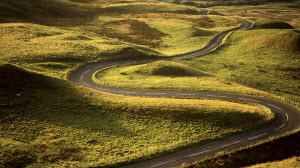
The road isn't segmented into definable sections… it flows along as one continuous, undulating strip of asphalt. Your cyclists may appreciate your class more if it flows like the road they ride. Here's why & how…
Common practice for many of us is to construct a class profile out of a playlist of songs:
- Warmup songs followed by
- Songs that communicate Flats
- Songs the communicate Climbs
- Interval songs
- Recovery songs
- Cooldown songs
- etc…
The end of each song signals a transition. We'll use that brief change to cue the next segment “now we're going up!” or “nice flat road ahead” or something similar. A gap follows the end of each track – before a new section of road begins.
But the road really doesn't work that way, especially when it comes to random rollers or out-right climbs. Everything is connected. Flats flow into climbs, the downhills back to flats and the flats are broken up by rollers. Your; speed, heart rate, power and even your ability to recover once over the summit, was determined long before you needed to shift down with the increase in grade.
I wish I was wearing a recording Heart Rate monitor this past Tuesday night, because a graph that showed the 2 1/2 hours of my HR would have told the tale much better than I can describe here in words.
Everything on the road is connected… there are few, if any, gaps… I'm realizing now that I had been training my class (and myself) like there were.
It was the first Tuesday night Life Time Fitness outdoor group ride. Me and my very fast VeloVie Vitesse showed up with a just a little bit of anxiety. “Which group are you riding with, John… the “B's” or will you being going out with the “A” group?” Great question and at that point I hadn't really decided. Of the 40 or so riders in attendance, I recognised almost everyone as either other Instructors or past participants. Maybe it was just me, but I got the sense that some of my regulars were watching to see what I was going to do.
These are well organized rides, with designated “Ride Leaders” who are paid LTF employees. After a brief welcome and introduction of the A, B and C leaders it was time to roll out. “A' group goes first. “Riding with us John?” Of course I was. My pride and ego didn't leave me with any other choice 🙁
The LTF “A” group has a well deserved reputation as an ego driven, hammer fest. Even though this was night #1 you wouldn't have known it. They start out fast and only get faster. The first 30 minutes are spent working our way out of town, to some very nice rural country roads. Here's where the fun begins and the reality of how everything on the road is connected came front & center to me.
If I can slot in tight behind a big guy, hanging with a paceline @ 26mph is a near threshold, continuous effort. Challenging, but doable. CoRd 6, as it winds west of the cities, flows through a series of rollers. Each change in grade required a substantial increase in power to maintain my sheltered place in the group.
The downhills that follow aren't for recovery. Nope. They're for building back your average speed. Well that's my theory anyway because once I crossed each summit I was forced to shift up to keep with the acceleration that followed each short climb.
I found myself trying to do two things at once (well three if you count staying focussed on my chosen wheel);
- Fight to recover from the previous effort…
- While mentally preparing for would come next
I've described this as “recovering on the run” to my class. How your group doesn't slow/stop at the top of a climb to give you a chance to rest. They keep going. If you're committed to stay with them, you need to accept whatever reduction in effort you're offered and use it to recover as best you can. Over time, with a slight reduction on power output, your HR will come down. You just need to wait for it – or slip off the back and soft pedal until the “B” group catches you.
I told this story to my class this morning. How out on the road everything is connected. There are no “gaps” between segments. Only small changes in effort. And while I talked about my ride… we rode a class without gaps. Flats flowed into rollers and we accelerated down the back. Slight reductions in effort on the flats, followed by more of the same.
Over and over, just like the road.
Originally posted 2013-05-02 09:56:10.
by John | Mar 14, 2013 | Leading Group Rides

My new Carbon Fiber VeloVie 300 Vitesse was delivered yesterday! Now if the weather would improve and melt all of this dang snow, I could actually get out and ride it.
I purchased my new Instructor Bike (I give everything a nick-name… our Trek Tandem is called The Bus) through our new ICI/PRO Purchase Program – members get access to heavily discounted pricing from VeloVie – kind of like what they offer to their sponsored Pro Cycling Teams.
My bathroom scale says my new Instructor Bike weighs 14.6 lbs. I'm not sharing what the bathroom scale displayed for the weight of the Instructor…
I took a bunch of pictures while I un-boxed it, to share so you see how it's shipped and how easy it was to assemble using a multi-tool. My next stop will be March 24th @ 4:00 for a 2 hour fitting with Chris Balser – the Bicycle Fit Guru.

Here at last!

Everything was well packaged.

Reynolds Attack Carbon Wheels – they feel like they weigh about half what my old Mavic Carbone wheels did.

First look

FSA Carbon Seat Post / set-back per Chris Balser's instructions. Excited to try this selle italia saddle.

This bag has a few little bits

What's inside

Part of the padding was this t-shirt

All the packing removed

Be sure to save all the packing – You have 12 days to return this for a full refund.

Attach the rear derailleur to the hanger.

Handel bars are next

Then the seat post

Front wheel – the skewer lock goes on the RH side so you can squeeze the front brake lever with your right hand to center the wheel and tighten the skewer with your left hand. Those pretty blue brake pads are specifically for carbon rims 🙂

I installed the rear wheel and found I hadn't attached the rear derailleur correctly. That floating cam holds the derailleur in the proper position.

Add some LOOK pedals and my Instructor Bike is ready for the road… well once I've been fitted properly she'll be ready. If it gets over 35 degrees Saturday, I might just get things adjusted close and go for a short ride around the neighborhood.

14.6 lbs – I'm not sure how accurate my bathroom scale is but it sure feels light.
See the details of the ICI/PRO VeloVie Bicycle Purchase Program.
by | Apr 15, 2010 | Health and Wellness, Melissa Marotta
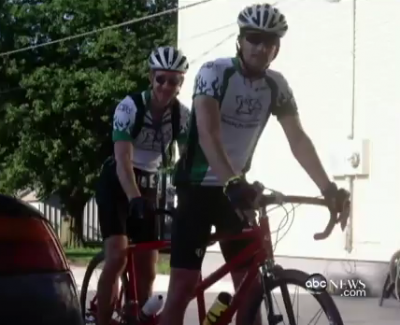
Dr. Jay Alberts and friend on his tandem bicycle
Last week, the new York Times ran a fascinating article describing the case of a man with severe, debilitating Parkinson’s disease — who, while remaining largely able to walk, can ride his bike for several miles every day. Here is a link to a video showing him riding.
Since the article ran, I’ve received several emails from ICI subscribers, students, and classmates alike — all asking the same thing: “What’s the deal with this? How is this possible?” Truth be told, I had no idea. So, I decided to find out.
UPDATE: 2/10/14 There has been considerable research done to quantity the symptom relief experienced by people suffering with Parkinson's disease, by riding a tandem bicycle or on Indoor Cycles. Learn more by listening to this interview with Dr. Jay Alberts with Pedaling for Parkinson's.
UPDATE September 25 2014:
We are now offering an ACE approved Parkinson’s Cycling Coach training program. To learn if you qualify click here.
Background
What is Parkinson’s Disease?
Parkinson’s disease is a neurodegenerative condition (primarily affecting older people, though can occur any time) characterized by progressive destruction of part of the brain called the substantia nigra, which is responsible for the production of a brain chemical signaling molecule (see also: neurotransmitter) called dopamine. Since dopamine is the primary neurotransmitter of movement, Parkinson’s disease is marked by gradually worsening motor function. Its cardinal signs include difficulty initiating movements (“akinesia”) and slowness in maintaining movements (“bradykinesia”), including swallowing and speaking. Problems with balance, gait, and tremor are also very common1.
Current treatment options include Levodopa (essentially, synthetic dopamine) with supplemental use of drugs that boost dopamine or block its breakdown. Deep brain stimulation of the affected portions of the brain has also shown promising results. Still, even with treatment, the disease often causes significant disability and decreased quality of life2.
The Role of Exercise
The focus of treatment for Parkinson’s disease is largely medication-based. While a role for supplemental therapy with non-medication treatments (including exercise) has been thought to be important, most research over the years has focused on its effects on quality of life, not motor symptoms directly. In recent years, this is changing. There have now been recent studies demonstrating improved independent functioning3, balance and gait4, and walking endurance with exercise therapy5. In animal models, exercise has been thought to contribute protection against further brain deterioration6 — and even to potentially induce repair at the level of the brain7.
Can’t Walk but Can Ride a Bike?
Although exercise is recommended for patients with Parkinson’s disease to supplement their treatment with medications, the scenario described in the new York Times article is not the norm. What appears to be at play here is not merely a success story of exercise therapy; rather, it is a specific neurological phenomenon. Bike-riding, in this case, is not functioning merely as exercise. It is actually a mechanism whereby damaged brain pathways are being overridden. Allow me to explain.
You see, movement initiation can be in response to either an external (“exogenous”) or internal (“endogenous”) stimulus. Turns out, “akithesia” (lack of movement initiation) in Parkinson’s disease is largely a failure of ability to respond to endogenous stimuli. The exogenous pathway, however, remains intact8.
A phenomenon called “akinesia paradoxa” (like it sounds: paradoxical akinesia) has been well-described in the neurological literature since the late 1960s. This refers to the ability of people who have difficulty initiating movement somehow being able to move in the presence of visual cues (lines, objects, colors) at their feet8. Remove visual cues? “Frozen” again.
There is no research specifically on cycling-supplied visual cues responsible for akinesia paradoxa. It is reasonable, however, to think that perhaps it is the repetitive linear road markings that might be at work here. Or perhaps the cue isn’t visual at all — like music, which has also been studied in relationship to akinesia paradoxa, any one of the sounds (gliding, scraping, squeaking, etc.) we hear our bikes make as we ride can also be thought of as a repetitive cue. What may go unnoticed to us and our preoccupied senses may indeed be responsible for creating movement in the movement-less.
As amazing as this sounds, we must be careful not to go too far in our interpretations. All we know is that akinesia paradoxa happens — in response to a visual cue that generates a brain signal for movement, movement can happen. Research is still lacking as to whether these successful “cued movement” episodes have any long-term impact on disease severity. Still, this is an active and fascinating area of ongoing research. We’ll see what happens…
The writer is a third-year medical student at the University of Vermont College of Medicine. She is also a STAR 3 Spinning instructor, Certified Personal Trainer (ACE), and author of the popular blog Spintastic (http://spintastic.blogspot.com/), which applies patient-centered medicine to motivational coaching..
References
Crizzle M, newhouse IJ. Is Physical Exercise Beneficial for Persons with Parkinson’s Disease? Clin Jl Sport Med. 2006. 16(5): 422-425.
2 Rao SR, Hofmann LA, Shakil A. Parkinson’s Disease: Diagnosis and Treatment. American Family Physician. 2006. 74:2046-54,2055-6.
3 Yousefi B, Tadibi V, Khoei AF, Montazeri A. Exercise therapy, quality of life, and activities of daily living in patients with Parkinson disease: a small scale quasi-randomized trial. Trials. 2009. 10:67.
4 Gobbi LT,Oliveira-Ferreira MD, Caetano MJ, Lirani-Silva E, Barbieri FA, Stella F, Gobbi S. Exercise programs improve mobility and balance in people with Parkinson's disease. Parkinsonism Relat Disord. 2009: 15(Suppl 3):S49-52.
5 White DK, Wagenaar RC, Ellis TD, Tickle-Degnen L. Changes in Walking Activity and Endurance Following Rehabilitation for People with Parkinson Disease. Arch Phys Med Rehabil. 2009. 90:43-50.
6 Zigmond MJ, Cameron JL, Leak RK, Mimicks K, Russell VA, Smeyne RJ, Smith AD. Triggering endogenous neuroprotective processes through exercise in models of dopamine deficiency. Parkinsonism Relat Disord. 2009. 15(Suppl 3):S42-5.
7 Hirsch MA, Farley BG. Exercise and neuroplasticity in persons living with Parkinson’s disease. European Jl of Phys and Rehab Medicine. 2009. 45(2): 215-29.
8 Kaminsky TA, Dudgeon BJ, Billingsley FF, Mitchell PH, Weghorst SJ. Virtual cues and functional mobility of people with Parkinson's disease: a single-subject pilot study. J Rehabil Res Dev. 2007;44(3):437-48.
9 KM & Valenstein E. Clinical neuropsychology.. 2003. Oxford Univ Press: 4th Ed. p 299.
