
by Matt Wahleithner | Jan 8, 2021 | Best Practices, Engage Your Students, Instructor Training, KEEPING IT FUN, New Instructor 101
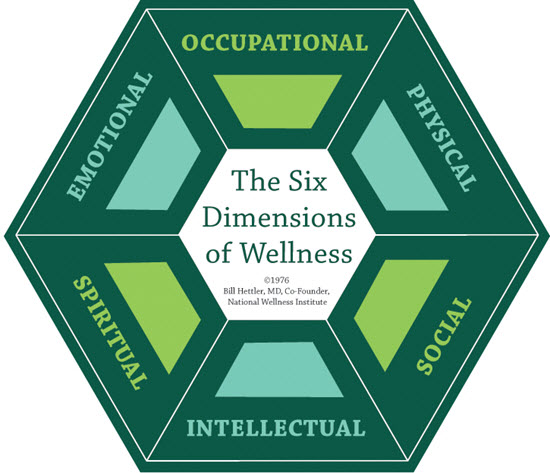
For years I have taught classes that were physically challenging to participants but when I started to bring more than the Physical Dimension of Wellness to my classes, MAGIC HAPPENED.
Dr. Bill Hettler, the co-founder of the National Wellness Institute (NWI), created a model named, The Six Dimensions of Wellness, in 1976. His idea of Wellness was not merely just the absence of disease, but living a life in which you become more aware and make decisions towards a more successful existence.
The dimensions from Dr. Hettler’s model are;
- Physical
- Social
- Intellectual
- Spiritual
- Emotional
- Occupational.
These 6 Dimensions when fully obtained can be thought of as a wheel, the more full your wheel is the better life may be, the less full the wheel is the harder life may be. Knowing this as a Fitness Professional, I made it a point to bring more than just the Physical Dimension to each of my classes and saw an improved mood and performance from members.
Below are a few ways to implement some of the Dimensions of Wellness into your classes and getting your participants to living more successful lives!
Social Wellness: I start each of my classes by having participants near one another introduce themselves and share their goals with each other, during the Warm-up. This really creates a sense of community and connection that might not be there unless you initiate it to happen.
The first time I tried this in class there was a silent pause and a look of hesitation of those in the room. I quickly followed up my request by sharing a stat that I read in Forbes Magazine, stating that those who share their goals with others, are 75% more likely to accomplish those goals than those who do not. This lit the fire and soon my classes were celebrating each other’s successes and helping hold each other accountable.
Physical Wellness: During the class it’s crucial you create a sense of connection with the body, whether it is Heart Rate, Perceived Exertion, or simple stating where and what they should be feeling. This help will get your participants engaged and understanding what’s happening PHYSICALLY rather than just going through the motions.
Whenever you get a chance during your classes, tell your participants exactly what they should be feeling so they know they are accomplishing the goals you have set.
For example, when I am teaching a Standing Attack Drill, I will prep the class by saying, “think of the word ATTACK, it’s strong, it’s powerful, and it’s aggressive! If you attack with those words in mind, your legs will start to warm, your breathing will become heavy, your heart rate will rise and when you finish this attack, you will be breathless and that much harder to beat! Let’s Roll!”
Your riders will now be able to connect with physical signs and feedback from their own bodies, which will be a great way to keep them engaged and working hard no matter if they are a beginner or a well-seasoned athlete.
Emotional Wellness: Towards the end of classes, I usually have a track where I give full control to the riders. I have a set directive for the drill and try to evoke an emotional attachment to their work effort and goals. I will ask again and again, “Is this the best you can do? Is this as hard as you can work, if so KEEP GOING, IF NOT MAKE THE CHANGE! BE BETTER!” I try to create a sense of pride and worthiness to their work and show them not just how PHYSICALLY strong they are but EMOTIONALLY.
This is all about song selection and coaching. The best example I can give that I use in my classes is the song, Breakn’ a Sweat by Skrillex & The Doors (Zedd Remix). The drill is simple; it’s a seated climb up the hill that scares you, the one you can BARLEY make it to the top of, the hill that when you get to the top, you feel victorious. The gear choices are up to you but the RPM’s must never go below 65. Ever rider will have a different idea of what this hill looks and feels like. It then becomes the instructor’s job to coach their team of riders up this hill and make them believe every second of the way that they can do it.
Spiritual Wellness: Finally at the end of class, during the Cool-Down, I always have participants turn to their neighbors and give them a good-job or some words of praise for their work. The Cool-Down to me has 2 parts to it, first to bring recovery and relief to the body through a controlled ride and stretches, and second to feel a strong sense of pride for the effort and work they did during class.
As soon as the last beat drops and the work part of the class is over, I always tell my class to turn to their neighbors and commend them for their effort during class. I also always make sure that the song or songs that I use for Cool-Down provide motivation or inspiration, like the song, I Lived, by One Republic. The lyrics talk about taking chances and, my personal favorite, OWNING EVERY SECOND! As the leader of your class, assure your team of riders that the effort they put in is one they should be proud of and feel good about.
Since the implementation of these techniques I have seen a steady retention and full classes. When you start to introduce these Dimensions into your classes, be authentic and go in wholeheartedly, and you too will see MAGIC HAPPEN!
Originally posted 2018-09-27 11:19:55.
by Joey Stabile | Apr 7, 2019 | Health and Wellness, Instructor Training, Mental Toughness, New Instructor 101
Below is a summary of an outstanding article that I read on Training Peaks. The original article published on March 28, 2019 · By Maria Simone can be found HERE.
Many slogans that you find about doing work can inspire and motivate! However, it’s only through doing the right work that you will make our big dreams a reality. We can think about doing the right work in three ways: consistency; discipline with intensity and volume; and recovery.
Consistency
Consistency is the most important element of any training plan. In order to build your fitness and prepare your body for the demands of race day, or a really hard class, you need to be able to train daily.
To train consistently, we need to plan ahead in order to balance training with other life priorities. Of course, in some cases, it may not be possible to fit the scheduled training on a particular day. If you are self-coached, review the rhythm of the plan. Consider whether it’s possible to swap days, shorten or modify a workout, or skip the session when unexpected conflicts arise. When all else fails, remember one day here and there won’t ruin your overall consistency. Try not to regularly miss key workouts or rethink the flow of the plan and/or your life schedule to set yourself up for success.
Discipline with Volume and Intensity
A second area where athletes unknowingly sabotage themselves is in their discipline sticking to intensity and volume targets. It’s important to stick to the targets for how hard or easy a workout should be (intensity) as well as how long or short a workout should be (volume). All too often athletes like pushing their endurance-based workouts into a tempo or Zone 3 effort because they feel like they aren’t working hard enough. Unfortunately, by raising the intensity, the athlete no longer reaps the endurance benefits, and they are not working hard enough to reap the benefits of a high-intensity session. We often see this in our classes. This is where we are doing work, but not the right work.
Recovery
Recovery is central
to your body’s ability to adapt to the training sessions. Training
breaks you down – recovery lets your body put itself back together.
How can we enhance recovery? The most important recovery tool is sleep. According to the National Sleep Foundation, sleep deprivation or “sleep debt” increases the production of the stress hormone cortisol while decreasing the production of glycogen. This combination means you won’t wake up feeling ready to tackle the day’s training session.
Beyond sleep, you can enhance recovery with daily nutrition, as well as properly fueling and hydrating before, during, and after workouts. If you aren’t putting the right gas in your tank, your car won’t work the way you want it to. If you aren’t incorporating a consistent recovery protocol into your training plan, then your body won’t adapt to the training stimulus.
Proper training isn’t just about doing the work. It is about doing the right
work, which includes a focus on consistency, discipline with your
intensity and volume, and recovery. Get the mix right, and you will
continue to see your body and mind working properly towards your next
big dream.
by Sarah Cummings | Sep 19, 2018 | Health and Wellness, Instructor Training, New Instructor 101

If I could tell you that I had access an incredibly effective performance enhancer that couldn’t be picked up on any drug test and is completely and utterly free, I’m fairly sure you accuse me of lying.
What about if I then said that you had unlimited access to it too? You’d probably just shake your head and walk away. Well it’s all true. What is this wonder drug? Sleep. That’s what.
Sleep has been called the most potent natural performance enhancer known to humankind. With very good reason. Below we take a brief look at exactly how sleep and athletic performance are linked…
Sleep and training
Getting sufficient rest is vitally important for all of us, athlete or not. It plays a role in just about every single thing we do, The Sleep Advisor team discuss this in great detail. But it’s importance takes on new levels when you start putting your body under unusual amounts of physical strain — like training for a race for instance.
No amount of hours spent on the track or gym will make you into a top athlete if you are not sleeping well. Those hours pumping iron or pedaling furiously are actually doing your body harm, you are tearing muscle fiber down. it's only with sufficient down time that the body is able to repair and reinforce.
Any training regime that clocks up the hours spent in the gym or on the track, without making account for sufficient time to allow the body to repair itself, is doomed to end in failure.
So if you are looking for things to cut out of your schedule to make space for more training don’t you dare thing about cutting your sleep shorter. Dump the girlfriend, quit the day job or cancel your Netflix subscription. But don’t cut out on sleep. If anything you should be sleeping more.
Sleep and motor skill acquisition
When it comes to learning new skilled actions and behaviors such as those needed for athletic success, it has long been thought that practice is the only thing required for improvement. Studies now suggest this view to be too simplistic.
Research now suggests that the brain continues to learn even when the day’s practice session is over. In fact it’s during sleep that night that the brain consolidates any new techniques learnt during the day. Say for instance you’re working on a new tennis swing, it’s during your sleep than the brain replays the action over and over again.
So remember, it's no longer just ‘practice that makes perfect’ when it comes to mastering a new technique. It’s ‘practice, sleep, practice again, makes perfect’. Not quite as catchy I will give you that, but more accurate.
Sleep and performance
The gap between medal winners and also rans (or also-cycled), often involves little more than hundredths of seconds. Sleep has a huge impact on cognitive performance. The difference between winning a race and finishing dead last could be as little as an hour more (or less) in bed.
Don’t believe me? Ok. Just as a thought exercise, try and recall the last time you had a bad night’s sleep. Statistics suggest you won’t have to think too hard on this. Now consider for a moment what your reaction times were like. I bet it took you a good five minutes to even decide what breakfast cereal to have. Now imagine you’re on the starting line waiting for the gun to go off. Yikes!
The impact poor sleep has on reaction times has been compared to the impact alcohol has. And no athlete looking to perform at the highest level would dare turn up to race after a couple of pints. In terms of performance that’s exactly what they’re doing if they turn up after a bad night’s rest.
Sleep and injury
Excelling at your chosen sport is a lot to do with consistency, are you able to get out there week after week and perform at a high level? If the answer is no, it might not be because of a lack of talent but because your body simple can't cope.
Study after study has shown that one of the most reliable predictors of injury in athletes is how well they sleep. It’s quite simple, athletes who got eight or more hours a night have been shown to get injured far less than athletes who sleep less than eight hours.
There seems to be two main reasons for this. The first relates to what we discussed above, our body needs time to repair and prepare, sleep is this time. If we don’t get enough sleep or our sleep is broken then those repairs and preparations aren’t properly carried out. The result is injury.
Training without sufficient sleep is kind of like driving the car out of the garage before the mechanic has put the engine back together and bolted the wheels back on. You might get a little way down the road but it ain’t gonna be pretty!
The second reason for the upturn in injury amongst sleep-deprived athletes relates to cognitive performance. When we’re tired we’re low on energy and our reaction times are significantly impaired. To make up for these shortfalls we overcompensate. We stretch further than we should. Tackle harder than we need to. This overexertion leads to poor technique. Both of which can lead to injury.
If you’re an athlete and you’re trying to work out why you keep getting injured or why your times simply aren't improving as you’d hoped — maybe it’s not your training or your diet that needs altering — but your bedtime. Sweet dreams!
by John | Apr 9, 2018 | Best Practices, Engage Your Students, Instructor Training, New Instructor 101
I'll let you in on my little secret.
I edit many of my interviews. When my guest misspeaks, has a few too many ums/ahs/likes/you knows or they run off topic. They tend to say “stop” and then ask “please edit that out”.
Although I've been asked multiple times, I never agree to let a guest listen and then approve the final recording. I also never agree to edit or delete anything just because a guest says; “I sound awful!” I've learned that people are just too critical of themselves > especially when they're not used to hearing a recording of themselves in conversation
But more frequently I'm editing myself out of the recording. That's right. Even after recording over 300 interviews I still; talk way too fast and my tongue get's all tied up, signal my agreement with the same, tired; “that's awesome” or “OK, so…” and it drives me crazy!!!!
So I edit it much of it out and you never hear it 🙂
Unfortunately none of us has an edit button we can hit during a live conversation or class presentation.
Like you, I love learning and improving. I've recently been going through an online training course to improve my speaking and presenting skills. The course is called How to Create a 1000 Watt Presence Learn business communication skills for personal and career success by actress and communication coach Alexa Fischer. I really enjoyed this particular video (one of over 40 in the course) and Alexa has given me permission to offer it to you.
What grabbed me during the intro of this video is when Alexa says; “But unless you're a professional performer….” Aren't we all are Professional Performers? The PRO in ICI/PRO is short for Professional…. as in Indoor Cycle Instructor Professional.
I feel I am a Professional. Do you?
Here is the PDF she refers to that you can use to (as she says) compassionately critique your recording and then begin the process of improving your communication skills through changing how you speak. NOTE: the correct link to the Fricken Fillers video is here > it's broken in the PDF.
Here is a past Podcast that explains an easy way you can record your own class, using your iPhone or Android phone.
You can check out Alexa's complete training program here at Udemy.
by Joey Stabile | Feb 28, 2018 | Best Practices, Bonus Materials, Creativity Indoor Classes, Instructor Training, iTunes, iTunes & Spotify Training, Music, New Instructor 101, Spotify

This is post one in a multi-post series that will explain how to use and select music to compliment your class. As the series progresses, I will be sure to include the links to the previous posts so that the entire series can be found in the latest post.
As an instructor, music can become the most challenging part of any indoor class; however it can be one of the most important parts of the class. I have heard it said that we are not DJs on a bike, we are cycling coaches. While I may agree with the sentiment, we can not underestimate the importance of music in the delivery of a class. You could structure the most ideal training program with the very best designed drills, but if your music is off and does not match the work, chances are very good that the class will disappoint your riders. While we believe that the class focus and design should be well thought out before the music is added, the addition of music to your drills will truly make or brake your class.
What is it that makes the selection of music so crucial; music is a one of the most powerful mediums. It can facilitate communication that goes beyond words, enables meanings to be shared, and promotes the development and maintenance of individual, group, cultural and national identities. Music can alter movements, moods and emotions. Few other items that you come in contact with can effect such a wide range of human functions and feelings.
So, how do we begin with the so important task of selecting the right music for your class? It all begins with belief. You must believe in your music and your playlist or your class will not believe in it either. While there are seemingly endless types and styles of music and everyone in your class can have a different preference, it is your ability to believe and sell the ride that will matter. To make it a little easier, if you incorporate some basic principles, you will succeed more times than not:
Know Your Demographic
The demographics of an indoor cycling class can be affected by many factors including your club’s location (city vs. suburbs), day of the week and time of day that your class is offered, and if your class is designed around a specific focus or theme. One of the easiest ways to accomplish this principle is to take the time to learn what your riders like by simply asking them. You will never be able to please everyone all of the time, but people appreciate being listened to and will respect you if they believe your are doing your best to give everyone something they enjoy. Please, remember to remind your people that not all great music is great indoor cycling music and that it may take a few weeks to get their requests into one of your rides.
For Foundational classes (beginner), remember the overall focus is to provide a fun environment for people to gain some initial cycling fitness or possibly just fitness in general. With the exception of the warm-up (and possibly the cool-down/stretch), working songs should be music your riders will recognize, and maybe even sing along to. While the beat matching of the ride is still critical, you should take extra time with this group to be sure the music is fun and will keep them coming back for more.
For intermediate and advanced classes, it is critical that the music be beat-matched and of similar intensity to the work that you are asking of the riders. When we ask more of the riders, this also demands more of us as instructors. We need to put in the extra time to find “just the right music” that will not only support our drills, but it will also enhance them. Ideally, the riders should be able to close their eyes, or look away from the cycle display, and still hold the proper cadence by focusing on the beat and feel of the music. Aside from the beat, the intensity is also important: an epic climb demands an epic musical work to help us reach the summit.
One of our foundations at Cycling Fusion is that songs used for the first warm-up segment should NOT have vocals. The warm-up is where you spend a good portion of the time introducing yourself, the purpose of the class and give various instructions such as safety guidelines, proper position and how to gauge the level of effort. It is important that your voice be the only one heard in the cycling studio during the warm-up so riders have a clear understanding of expectations and how to approach the class.
In the next post, we will talk about Pulse, BPM and RPM and how using them will enhance your ride and heighten the student’s experience.
by John | Apr 25, 2017 | Best Practices, Instructor Training, New Instructor 101, Zone based Heart Rate Training

I'm noticing that Polar is now promoting a three heart rate zone system.
Welcome to the party Polar!
I subbed this morning and saw the sign on the right displayed. At first I didn't give it any notice, but then I did a double take; they're showing the five zones grouped into three… very interesting.
When I got back to my office I did an image search to see what else I could find. I haven't paid much attention to Polar, so some of this could have been occurring and I'm only seeing it now.
At Polar's website they have a specific area titled: Improve Fitness and then a sub-page: The Three Exercise Zones
Exercise zones are ranges between the lower and upper heart rate limits expressed as beats per minute (bpm) or as percentages of your maximum heart rate (HRmax). HRmax is the highest number of heartbeats per minute during maximum physical exertion.
Heart Rate Target Zones
Exercise can be divided into three different: intensity zones. Each of these intensity levels corresponds to various health and fitness improving mechanisms in your body.
Here's what I found.
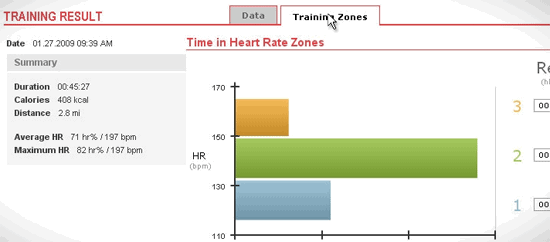
ACE promotes a Two Threshold & Three Zone System. Polar's personal training area clearly reflects this in the chart above.
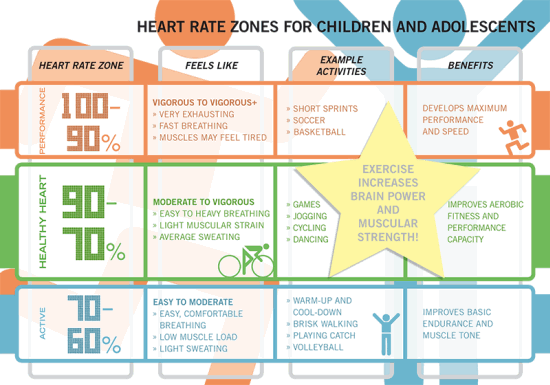
Ignoring the fact that all of this is based on the antiquated Max Heart Rate – instead of a being based on aerobic or anaerobic thresholds – I see this as very good news for any of us trying to cut through the confusion and complexity caused by branded 5 or more zone systems. Instead we promote the simple and effective 3 Heart Rate Zone system anchored by both aerobic or anaerobic thresholds.
It's great to have Polar aboard – except they have a long way to go… please forgive my rant here 🙁
It defies explanation, how a company as large as Polar, can be so utterly clueless. Make sure you've completely swallowed whatever you're drinking before reading their page about; Determining Maximum Heart Rate.
Your heart rate has an upper limit, or maximum rate, called HRmax. HRmax is not a good predictor of fitness level or performance (it's mostly genetic), but it is used to quantify levels of intensity (as a % of HRmax). If HRmax isn't good for anything, why are you using it? It's like saying; this scale is wildly inaccurate… so go ahead and weigh yourself with it and we'll base your weight loss program on it.
You can determine maximum heart rate a number of ways:
1. Have your HRmax measured in a laboratory during a stress test. In a laboratory? OK sure, I have one down the street.
2. Do a maximal effort and record the highest heart rate (not recommended for untrained individuals). This will give you a fairly accurate maximum heart rate, but is difficult to do properly. Remember that HRmax depends on the activity, so establish HRmax in the sports you do most often. Huh? What's your definition of the word “fairly”? So if I'm “untrained” what do you suggest I do?
3. HR max-p score predicts your individual maximum heart rate. This feature is included in several Polar computer models. I get it – marketing types wrote this nonsense.
4. Estimate your maximum heart rate based on the formula 220 – age. This will give you a rough estimate, but is not nearly as accurate as the other methods described above. That's it? Those are your only choices?
For most individuals, maximum heart rate declines with age and values are usually between 170-200 bpm. This has been disproven years ago – why do they continue to say it?
We've been proponents of the Two Thresholds /Three Heart Rate Zone system for years here at ICI/PRO. We're not alone. ACE ( the American Council for Exercise) recommends this system as the most appropriate for the typical participant we see in class.
Here are links to past articles and Podcasts.
I've discussed the need for standardised heart rate zones to cut through all the marketing B.S.
https://www.indoorcycleinstructor.com/icipro-instructor-training/zone-based-heart-rate-training/ici-podcast-177-problem-solved-two-threshold-three-zone-heart-rate-training-in-a-blink/
This is the first in a three part series that includes a video produced by ACE that demonstrates an aerobic threshold assessment
https://www.indoorcycleinstructor.com/icipro-instructor-training/zone-based-heart-rate-training/is-a-20-minute-threshold-field-test-realistic-for-your-class/
Originally posted 2013-05-21 14:52:43.

