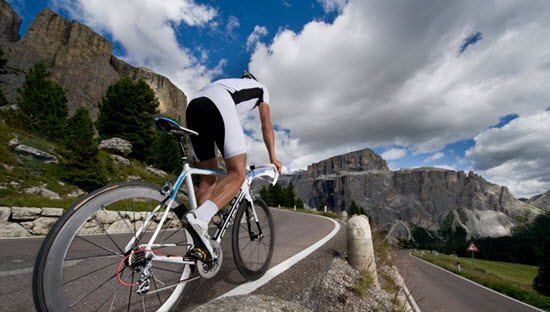
We are less than 60 days from our ride around the Cabot Trail. The group has been very active – increasing distance to 55 km for morning rides, grades to 7+% for hill repeats and making lots of connections between the indoor and outdoor efforts in my classes.
We closed the opportunity to join us last week so that we’d have a consistent group with whom to train over the next two months. Twelve people will ride the Trail. At a maximum we had 17 people on one of our Sunday training rides. As word got out, friends of friends started to attend and we welcomed their interest. They will be invited to re-join us for some weekend jaunts this fall.
Here are some highlights relevant to the indoor/outdoor cycling interface.
We did a quick reconnaissance of the route last weekend and some of the descents are daunting. As I negotiated the road in a car I became painfully aware that no amount of indoor cycling can help people learn how to descend. We have been working on those skills outdoors but can’t reproduce the Trail experience nearby. I have contracted a Can-Bike educator to give the group a lecture and clinic. Meanwhile we’ll content ourselves with the knowledge that less prepared people ride the Trail every year and none of them have ended up in the ocean.
The transformation of individuals from bikers to cyclists is noticeable. I am most thrilled by Judy who panicked and bailed on her first attempt at a road ride last fall. She was the first to buy a new bike this spring, always turns in her training logs and is now one of our strongest riders. Better yet, when the group organizes its own trips during the week, she consistently chooses the one that will give her the greatest challenge. I am writing up an interview with her which I think will interest you as she describes the indoor to outdoor experience.
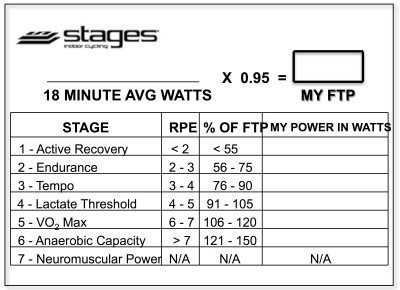
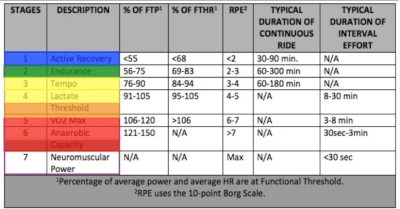
I teach in a facility with a mixture of non-power and power bikes. That precludes classes which are entirely focussed on power. Recently, though, I have been able to let everyone re-visit their FTP (60 min). The numbers range from 1.4 to 1.9 watts/lb (measured over 20 minutes and corrected for 60 minutes (x .90)) for the group who is doing the Trail. Remember – these were non-exercisers/non-cyclists a few months ago. They have all seen a huge increase in their power over that period. Better yet, their results are completely consistent with what they see in one another on the road. The power info has really helped the weaker riders understand the connection between indoors and outdoors.
You can read my earlier posts about preparing a group of Indoor Cycling students for our trip to ride the Cabot Trail here.
Master Instructor Tom Scotto delivers our latest Audio PROfile Climbing Strength Intervals. PROFILE OVERVIEW
This profile is called Climbing Strength Intervals. It is a simple profile that focuses on four 3- minute climbing intervals designed to test and develop muscular strength. Riders can track their heart rate and/or power during the class to gauge their individual climbing efforts. The beauty of this class is that it takes a simple look at one concept of heart rate and power training and reduces the risk of overwhelming people. This profile can be introduced without any previous training on heart rate or power. It is a simple way to explore and learn.
Here’s your Spotify PRO/Playlist!Deezer. We have made every attempt to replicate the original playlist. In some instances the tracks specified were unavailable in Spotify. When necessary we have substituted individual songs of similar length and tried to maintain the Instructor’s intent.
Long climbs have you bumping up against your power ceiling.
I prefer to limit the mathematical computations many Instructors typically ask of their classes. For example you’d never hear me say;
“now I want everyone at 85% of their FTP” or… “this next interval is 30 seconds in Zone 5B which is 103 to 106% of your LT/AT heart rate followed by 2 minutes in Zone 3 = 90%-93%”… everybody got that? Then let’s GO!!!
I’ll admit that part of this is due to my phobia of math. It’s also because I recognise that there are a wide diversity of personalities riding in front of me. Sure, I’ve got a few engineers who could probably spit out the square root of their FTP between pedal strokes if you asked, but it’s my impression that the majority of folks in your class would prefer that you leave the math for times when they have a calculator handy 🙂
Just this past Sunday I had two women in my Performance Cycle class cheer when I mentioned that I wouldn’t be requiring any percentage figuring that morning.
But we still need to communicate intensities, right? That’s where establishing Floors and Ceilings comes in. They’re simple concepts everyone will understand – we all know what’s below a floor or when we’re up against a ceiling!
Master Instructor Dennis Mellon using this same Floors and Ceilings concept in his classes, except a little differently. We discuss how we each use them to (hopefully) communicate effectively, in this ICI/PRO Podcast episode.
[wlm_private ‘PRO-Platinum|PRO-Monthly|PRO-Gratis|PRO-Seasonal|Platinum-trial|Monthly-trial|PRO-Military|30-Days-of-PRO|90 Day PRO|Stages-Instructor|Schwinn-Instructor|Instructor-Bonus|28 Day Challenge’]
Please let us know your questions.
You can read more about using VT1 Aerobic Threshold and VT2 Anaerobic Threshold to create easy to understand Floors and Ceilings here.
I taught my last class today. My last ride so-to-speak. It all started seven years ago. I had been Spinning® for years. That day our regular instructor asked me to lead her class. She was just too sick.
To me – a pilot – it was like being asked to safely land an airliner because the pilots were incapacitated. Truth be told, I was far more prepared to land a 747 than lead the class. But I did it, and that is where my ride as indoor cycle instructor began.
Penning this post for ICI/PRO is – for the most part – where it ends. A memoire of sorts that highlights milestones of my journey from certified but lost, to Master Instructor, what I learned along the way about our craft and our industry.
Realizing the joy of being in the front of the studio, I took the first of countless certifications the next month. A one day, eight hour class. Leaving that afternoon I realized what I didn’t know.
I knew that to be the instructor I wanted to be, would require more than eight hours. So I did what all red blooded Americans do, a Google search on teaching indoor cycling.
Lucky for me John understands search engine optimization. ICI/PRO was top of the list and my life as an instructor changed.
Back then John was publishing ‘podcasts’ and posts talking about something he called Indoor Cycling 2.0. What?? I was in my car a lot in those days with my iPod plugged into the radio. I listened to it all trying to figure the best way to integrate such wisdom into my teaching.
There were guest speakers who discussed everything from music to very cycle specific training.
There were posts from this guy, Gene Nacey, who had started a company called Cycling Fusion. Gene wrote a book back then about training with power. The forward, written by Sally Edwards. Who were these people and why are they always talking about heart rate, power and cadence?
ICI/PRO offered class profiles with music suggestions. I found these very helpful but they had names like muscular strength or climbing power or aerobic volume training. It was all very overwhelming.
I realized what made it so overwhelming was that I had not really been educated. That my eight hour class hardly scratched the surface of what ‘training’ on an indoor cycle was really about.
My experience taking classes was just the opposite. My favorite instructor never did any of this stuff. I had reached a defining moment. Indoor cycling version 1.0 or 2.0.
I chose 2.0 because it had the education I yearned for and the structure that seemed missing from the classes I took. I had always been a fan of heart rate. Moreover, the new bikes at the JCC – where I was trying to land a sub job – measured heart rate and had power meters. I knew that seemed like the perfect combination but – at the time – had no idea why.
I got the sub job and a fair amount of opportunity to teach in those early years. I began my quest to get better through education. My sub classes (all I had at the time) were – unbeknownst to them – my guinea pigs.
Having read Gene’s Power Training Book there were some questions. I had found a way to land a ‘regular’ class in prime time by offering to do a power training course. I had questions, so I called him.
Gene is the quintessential professional. He always gave freely of his time to answer my questions. But he warned me, “Chuck where you are going you will discover a culture, the culture of indoor cycling. Good luck.” But more on that later.
Later that year he was doing the official launch of his new company, Cycling Fusion by hosting a summit of some of the most nationally regarded indoor cycle instructors. I’m not sure where I found the nerve, but I offered to kick off the summit suggesting that I was representative of the new 2.0 instructor. To my surprise Gene said yes.
The rest is history. My relatively short, but incredibly intense career really began at that summit, west of Denver high in the Rocky Mountains at Keystone Ski Resort. Why? I met Sally Edwards. Talk about unbridled energy. Sally – the only person ever inducted into both triathlon halls of fame – epitomizes it.
Suffice it to say that when I ran into Sally at the Denver airport after the summit I knew I was home. John led me into the room, Gene opened the window and Sally was the sunshine that poured through. There are not enough words to describe the learning one experiences working with Sally Edwards.
But if Sally was the sun shining on my personal learning crusade, Jim Karanas was the fresh air flowing through the open window.
Jim was indoor cycling 2, 3, 4 and 5.0 way before anyone ever heard of a ‘podcast’. Sadly, Jim left us a while ago, but his legacy lives on in all of those he touched. From Jim I learned to put the icing on the cake. That at the end of the day, it was not about me or just about heart rate or power, cadence or cycle specific training. It was about bringing to class the ability to touch each rider such that they were sure I was teaching class just for them.
When I made the choice to give up leading classes I did it with the knowledge that I had met my own challenge – to understand the whole of indoor cycling yes, but to touch the people who trusted me in a positive manner. How did I know? Simple really, rider feedback. Additionally, I had grown past the place where I was committed to only one way. I was comfortable teaching outside the keep-it-real philosophy that had governed my every thought for so long. I knew that Indoor cycling 2.0 was only a pass to explore and learn, not a rigid protocol to vigorously defend. That my job was not to suppose I knew what my riders needed, or how they got it, but to provide for them what THEY thought they needed that day. I can do that. I have done that. I am content. I have moved on but I have not forgotten.
In the coming weeks I will give John some additional posts written but never submitted. Posts that take a close, perhaps inside look at the realities of our industry. Fruit for thought or maybe, fuel for a fire.
It has been my privilege to have met and worked with so many great and talented individuals.
I thought of this profile while I was sitting around the Thanksgiving day dinner table enjoying some great conversation with my brother-in-law’s family. Kent Harvey, my brother-in-law’s brother is a world renown cinematographer who specializes in adventure films and has been the summit of Mount Everest 2 times. Kent is an amazing and extremely safe climber. He is often asked about all the deaths on Everest and he always talks about the importance of saving enough energy to make the trip down from the summit. Summiting it great but it’s not worth your life.
In this month’s base profile I’ll be having my riders work to a peak wattage or intensity then slowly and steadily work their wattage back down from this peak.
Below you’ll find Week 1 of December’s @ or Above Threshold Keep it Simple and Progress indoor cycling profile.
2 minutes with a slight reduction in wattage or intensity each minute
1 minute recovery
4 minute interval increasing wattage or intensity each minute
4 minutes with a slight reduction in wattage or intensity each minute
1 minute recovery
3 minute interval increasing wattage or intensity each minute
3 minutes with a slight reduction in wattage or intensity each minute
1 minute recovery
2 minute interval increasing wattage or intensity each minute
2 minutes with a slight reduction in wattage or intensity each minute
90 second recovery
6 x 1 minute intervals w/30 second recovery after each
90 second recovery
6 x 1 minute intervals w/30 second recovery after each
90 second recovery
4 x 1 minute intervals w/30 second recovery after each
Workout Goal:
Can you increase your average wattage or intensity each minute to a peak?
Can you decrease your average wattage or intensity, only slightly, each minute after you reach that peak?
7 minute warm up
Slowly and steadily increase HR and/or Average Wattage each minute, for 5 minutes, up to threshold.
Slowly and steadily decrease HR and/or Average Wattage each minute, for 2 minutes, down from threshold.
8 minute ride up to peak and back down interval goals and specifics:
Slowly and steadily increase HR and/or Average Wattage each minute, for 4 minutes, up to a RPE of 9 out of 10
Ride seated with a RPM of 80-110
Slowly and steadily decrease HR and/or Average Wattage each minute, for 4 minutes.
Ride seated with a RPM of 80-110
Decrease intensity only enough to continue
1 minute recovery
6 minute ride up to peak and back down interval goals and specifics:
Slowly and steadily increase HR and/or Average Wattage each minute, for 3 minutes, up to a RPE of 9 out of 10
Ride seated with a RPM of 60-80
Slowly and steadily decrease HR and/or Average Wattage each minute, for 3 minutes.
Ride seated with a RPM of 60-80
Decrease intensity only enough to continue
1 minute recovery
4 minute ride up to peak and back down interval goals and specifics:
Slowly and steadily increase HR and/or Average Wattage each minute, for 2 minutes, up to a RPE of 9 out of 10
Ride standing with a RPM of 60-80
Slowly and steadily decrease HR and/or Average Wattage each minute, for 2 minutes.
Ride standing with a RPM of 60-80
Decrease intensity only enough to continue
1 minute recovery
6 x 1 minute w/30 second recovery after each interval goals and specifics:
Repeat four 1 minute intervals, increasing HR and/or Average Wattage with each interval
Ride all intervals seated with a RPM of 80-110
30 second recovery can be done in any position or RPM
Ride two 1 minute intervals slightly decreasing HR and/or Average Wattage for each minute.
Ride all intervals seated with a RPM of 80-110
30 second recovery can be done in any position or RPM
90 second recovery
6 x 1 minute w/30 second recovery after each interval goals and specifics:
Repeat four 1 minute intervals, increasing HR and/or Average Wattage with each interval
Ride all intervals seated with a RPM of 60-80
30 second recovery can be done in any position or RPM
Ride two 1 minute intervals slightly decreasing HR and/or Average Wattage for each minute.
Ride all intervals seated with a RPM of 60-80
30 second recovery can be done in any position or RPM
90 second recovery
4 x 1 minute w/30 second recovery after each interval goals and specifics:
Repeat four 1 minute intervals, increasing HR and/or Average Wattage with each interval
Ride all intervals standing with a RPM of 60-80
30 second recovery can be done in any position or RPM
Cool Down
[wlm_private ‘PRO-Platinum|PRO-Monthly|PRO-Gratis|PRO-Seasonal|Platinum-trial|Monthly-trial|PRO-Military|30-Days-of-PRO|90 Day PRO|Stages-Instructor|Schwinn-Instructor|Instructor-Bonus|28 Day Challenge’].