I’m super excited to participate at IHRSA 2015 next week – this is the largest fitness equipment/programing and services show in the USA. Our industry is continuously changing and many manufacturers launch their latest and greatest at this huge event.
Amy is joining me again this year and we’d love to meet you! We get into LA Tuesday 3/10 morning and will be there until noon friday.
Here’s the IHRSA promotional video – highlights from last year. I need to comment that Callie Bowling (a past guest on the podcast) picked out Amy and me registering last year @ 0:26 – recognising us both before she’d ever met us in person 🙂
First, who I’m excited to meet at IHRSA
I’ve know him “virtually” for years, but at long last I’ll get to meet David McQuillen of Sufferfest video fame. He is traveling from his home in Sufferlandria (which is on the opposite side of the globe) and will be there – booth #2554.
Cameron Chinati, Laurel Mylon and of course Dennis Mellon from Stages Indoor Cycling – they were notably absent last year – booth #2735
Both of the Display Training companies; Shay Amir with Spivi and Tae Yoo from Performance IQ.
Candice Mason is the Director of Commercial Sales for Mad Dogg Athletics. I’ve had the pleasure to talk with her by phone and I’m keen to learn what studio owner resources they’ll be offering at the show – booth #1135
My friends from Keiser; Darrin Pelkey and hopefully Dennis Keiser. Amy and I had a great conversation with Dennis last year and I’m very interested to get his insights on the state IC technology.
And now what I’m looking forward to seeing
Star Trac / Spinning® is displaying their new “Fusion Drive” belt drive option for the NXT and Blade Indoor Cycles. I’m hoping design engineer Justin Kleber will be there to give me all of the technical details.
I’m hoping that Les Mills will be displaying their new IMMERSIVE FITNESS video presentation system. I’ve heard nothing but, this is totally awesome, from anyone who’s been to their Santa Monica 24 Hour Fitness club.
MINDBODY is launching MINDBODY for Box, which they say offers workout and performance tracking. I’ve got no idea if this is targeted at their boutique studio customers, or (as the name implies) it’s only for Big Box studios… but then that’s why I’m going.
Wearable Technology like the Pulse ON watch that can read heart rate optically, without a chest strap.
And there are always surprises.
I’m not sure why, but ICG isn’t showing as an exhibitor this year – although they may be part of the Matrix display. And Schwinn/Stairmaster isn’t listed as a vendor either… UPDATE: Thanks to an email from Merrill Richmond I now understand that Schwinn is exhibiting along with the other brands owned by Core Health & Fitness, LLC – booth 1135. Merrill is now the Vice President of Marketing for Indoor Cycling brands Schwinn and Star Trac.
Stay tuned – I’ll be live blogging during the event. If you have anything you like me to look at for you, please let me know.
IHRSA is the big fitness equipment show held each year in the USA. Last year the show was in Las Vegas and I spent a bunch of time riding and comparing a number of new-for-2013 Indoor Cycles with power, including the Spinner® Blade Ion and Freemotion’s belt driven Carbon Drive S11.9.
There’s more cool stuff coming out this year. I’m excited to see the new power bike from ICG pictured above:
The IC7 Indoor Cycle and its Coach By Color® Power Program brings optimal performance and opportunity to group exercise, team coaching, personal training and even individual use. World-class technology and member-centric coaching will make your program more colorful, more powerful and definitely more original. That means better experiences and better results for your customers to keep them coming back.
Displaying colors connected to zones (Heart Rate or Power) isn’t new – but having the console glow where everyone in class and you (the Instructor) can see what zone they’re in is very interesting. Zone based colors brings accountability, without the judgement of actual wattage amounts that some riders and Instructors dislike in other group display systems. My hope is that there is a very quick and easy setup process to input the rider’s personal zones or thresholds that are tied to the different color zones. If you’re concerned that all those lights = frequent battery replacements, you needn’t be. The IC7 includes it’s own charging system. Oh, and they’re promising power accuracy of +- 1% and similar consistency between bikes. I’ll know much more by next Thursday.
A little bird told me that Keiser will be showing their new M3 power meter console that now features Bluetooth Low Energy (BLE) While everyone else is using ANT+ to broadcast rider data, Keiser’s engineers have leapfrogged to the new BLE which consumes less battery power and it will connect with your portable device without a ANT+ dongle.
This year the Senior Group Fitness Instructor Amy is joining me and together we’re excited to see all of our IC friends that we typically only get to talk to on the phone or Skype 🙂
Please let us know if you’re going to be there and feel free to text me to meetup 612-868-0064
As I prepared to support ICG at IHRSA 2013, I considered the ICG tenet that learning is about removing resistance.
I had just gotten back from a bit of Vegas shopping. A nice saleslady asked me what I was doing in Vegas and told me about the time she and her friends first tried indoor cycling. She loved it and was hooked, but her friends ran away and never came back. She explained that their initial reluctance to try something with a reputation for being hard had unfortunately been validated.
The cycling class tradition is steeped in that reputation — it’s crazy hard and the people doing it are crazier still. The reputation makes it difficult to get new riders. There’s built-in resistance to the classes. Regrettably, many instructors deliver indiscriminately on the reputation.
Yet we know that doesn’t need to be the case. How an instructor begins a class can go a long way toward removing resistance for first-timers. So I’ve developed a list. I’m not sure if they’re “Dos and Don’ts” or “Pros and Cons”, but certainly following these tenets during every class will help improve the reputation of indoor cycling.
YOU MUST GET THERE AT LEAST 15 MINUTES EARLY!!
This seemingly simple, yet consistently underemployed, strategy will put you in a calmer place. Your riders can feel your tension. Moreover, it gives you a chance to get ready without stress and bond a bit with your riders. Especially first-timers.
BE ATTENTIVE TO FIRST-TIME RIDERS
Many first-time riders will not approach you with that information. They tend to wander in, head to the back of the room, and look for a bike that fits. If you’re in discussion with your roadie friend, picking videos, lacing up your bike shoes, emailing or texting, you could easily miss them. Be on the lookout.
PERFORM A BIKE FIT TO GET TO KNOW THEM AND LET THEM KNOW YOU
I’m often made fun of for the amount of time I take doing bike fits for my riders. Well, LOL, for first-timers, the key is the time you give them, rather than how precisely you fit them. While doing the bike fit, I ask their name, talk about the console (if applicable), show them how to change resistance, define some terms I’ll use, explain the order of tasks (fun, cadence, resistance), and most importantly, explain how to modify anything I ask. Make your first connection here.
START CLASS BY WELCOMING THE NEW PEOPLE
I may catch some flak here because some people don’t like to be called out. But rather than calling them out, I simply state that we have a first-timer and have everyone clap. Then we get to it.
MAKE EYE CONTACT AND GIVE POSITIVE REINFORCEMENT
During class, check in on your first-timer. It’s simple. Watch. Make eye contact. Smile and nod reassuringly. If they’re struggling, find an opportune moment to get off the bike, turn off the mic, and give some help. Help other riders along the way.
TALK TO THEM AFTER CLASS
As much as practical, get right to your first-timers and talk to them. How did it feel? What did you like? What didn’t you like? Did you get the workout you expected? Where to buy cycling shorts and shoes. Welcome them into the community.
FINAL WORDS ON EDUCATION
Innovation has been the cornerstone of the ICG mission. Our approach to education — learning is a process of removing resistance — is a giant leap forward for indoor cycling. As an instructor, you have the opportunity to remove resistance and educate both your regular riders and beginners. The longevity of our craft depends on bringing in, educating and motivating new riders. Removing resistance is the first step. Take it.
At IHRSA, I worked the ICG booth and was fortunate — in some bizarre way — to be cornered by two club owners after my second of three demo rides. Both used the same language.
“You’re very good at teaching to video. But, of course, that’s why your company brought you here. How can we get our instructors to do as well as you and make their classes just as compelling?”
I explained that the best programs are those where the synergy between club management and employees is high. When management works closely with the group exercise teams to educate, promote, nurture and applaud, good things happen. The corollary is that management first needs to go in search of “the best of the best (and) make them better”. (Yes, I stole that line from “Top Gun.”)
They were surprised to hear that ICG’s online continuing education is free for everyone, not just those who buy our widgets. I explained our concept of educating by removing resistance. Our online modules are there for all — and you don’t have to start at the top. Nor do the instructors, who have learned a thing or two over the years, have to read all the chapters before taking the quiz at the end of each module.
As instructors, we can’t lose sight of the fact that, if we’re not working on improving our craft, then it could be better.
UPDATE: App developer Dave Norfleet is available to answer your questions posted below as a comment.
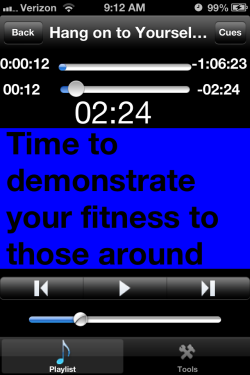
Schwinn Master Trainer Julz Arney showed me an interesting iPhone app when we met at IHRSA. She’s been using this app to build her class playlists and was really excited to show it to me.
I’m very tempted to use it (instead of Spotify) simply for the class count-down timer and numbers that are big enough to read with my 52 year old eyes!
Similar to ClassBuilder, MyFitnessDJpro is the creation of developer / Indoor Cycling Instructor David Norfleet.
David’s app is available in two paid versions:
MyFitnessDJ – $0.99 includes the count-down timer and you can select from a catalog of cues.
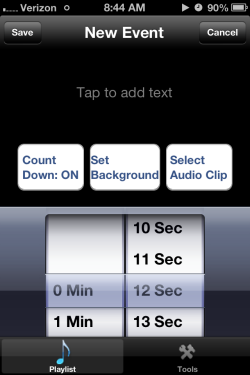
MyFitnessDJpro – $9.99 gives you the option to create your own cues like what’s shown here.
You can also select different background colors to help you instantly understand your intended intensity. If you want , you can add multiple cues to each track and insert them at specific times. It’s very entertaining to watch each new cue you’ve added, pop up right when you’ve set it – which could be set a few seconds before your change, giving you advanced notice of what’s coming next.
This feature could be very helpful when you’re trying to communicate a new theme or training objective in your class. Repetition goes a long way toward understanding. Having a number of reminders (to reinforce a specific / new concept) could go a long way toward keeping your message clear, and on point, without feeling you need to bury everyone with details in the first 10 minutes of class.
The pro version also includes an email playlist function, that you could use to fire off your music to an interested participant. David has also included an option to purchase and download some of his favorite playlists, if you need some external music suggestions.
Very cool.
If you found ClassBuilder too complex, time consuming or confusing – and yet you would like to be able to quickly add some easy to read notes to your iTunes playlist, MyFitnessDJ could be worth a look.
IHRSA 2013 demonstrated a major increase in club owners’ interest in virtual indoor cycling classes — rides led by a virtual coach or voice-over using Forward Motion Video (FMV). No instructor present. It was apparent at the IHRSA Trade Show that many club owners are now considering technology-based workouts.
Fitness companies have picked up on the benefits of virtual indoor cycling, chronicled by ICG in past posts. Some companies are investing millions of dollars in creating compelling content, geared to presenting a virtual experience that competes with live instruction. And an increasing number of clubs are realizing the economic benefit of offering and marketing virtual classes. These clubs range from budget clubs that have no intention of hiring instructors to major chains that support strong instructor programs.
Les Mills International (LMI) announced the launch of LES MILLSâ„¢ VIRTUAL at this IHRSA convention. LMI virtual workouts are based on master class content and demonstrated by their top instructors. These workouts will include virtual RPM classes, their brand of indoor cycling. Their filming and editing techniques are Hollywood quality. They have invested a great deal of money in making virtual classes that replicate the actual experience and energy of the master classes they present to their instructors all over the world.
The importance of LMI’s decision to provide virtual classes should not be overlooked. With their move to virtual and the high quality of their production, LMI, the industry leader in group-fitness programming, is indicating a shift in the industry’s acceptance of virtual classes.
Could virtual change the nature and economics of the fitness industry? The technology is fairly simple and getting better and cheaper. The content is improving. And the problems around maintaining an instructor staff are legendary. Ask any Program Manager: training instructors; making sure they stay current, show up on time, and fill out their timesheets properly; and much more. Virtual classes might just work in a major way.
So, speaking as an instructor, what are my options? If I support the use of virtual classes, and they keep improving, I could lose my job to a video of an instructor who’s much better than I am. If I don’t support it, my club owner may think that I’m not staying current in the industry, or that I have only my personal interests in mind. The owner may let me go, thinking I was the kind of instructor he/she wanted to get rid of, anyway. If I do nothing, I may suddenly be faced with a large screen and projector in the cycling studio and told to promote virtual rides to my students. Worse, I may be told that the club is scaling back its instructor-led classes because virtual is the future.
Here are the facts. Club owners see virtual classes as: a cost-effective way to boost class capacity and use the cycling studio at off-peak times; a way for members to fit classes into their busy schedules; a great way to introduce more people to group fitness and grow overall attendance; an effective marketing tool for enticing member prospects to join; a trend that’s here to stay.
To be proactive, I need to keep my instruction better than a virtual class. What can I do that video cannot?
1. I can learn people’s names and compliment them daily.
2. I can introduce them to others in the class and create a sense of camaraderie and group effort.
3. I can change my workouts and music for every class. (Some virtual programs are currently able to do this, but there’s likely to be greater repetition.)
4. I can get off my bike and provide individual coaching during class, as needed by the students.
5. I can improve my skills as an instructor, class leader, cyclist and dedicated employee so that, no matter who’s on the video, my abilities deliver a better class experience.
Having been a Program Director for over 30 years, I know that everything on the list above has been told to instructors in countless ways without large-scale success. The five items make you not only a better instructor, but also a better employee.
The industry is changing. I encourage everyone who is resistant to technology to change quickly. Invest in learning to teach with FMV, power, an iPod, or Spotify. Accept, even welcome, the advent of virtual classes.
Most importantly, do everything you can do to remind the industry that what makes group training most enjoyable is the social atmosphere and human connection that only you, the instructor, can create.