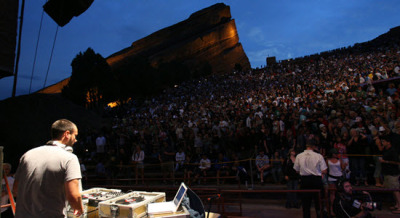
DJ Scott Melker playing the Red Rocks Amphitheatre in Golden, CO
As many of you know I've worn many hats in the fitness industry, I've been an Assistant General Manager, Operations Manager, Fitness Director, Triathlon Coach, Master Swim Team Coach, Master Educator, Personal Trainer, Group Exercise and Indoor Cycling Instructor. Throughout my almost 25 years in this customer service industry I have heard many member comments, complaints and compliments. Through these years I have grown a thick skin but the one comment that still cuts the deepest is when I hear that someone complains about my music. Being an indoor cycling instructor has, forever, changed the way I listen to all music. Music is now put into two categories; will this song work in class or not. I'm on a never ending search for the perfect indoor cycling song. This search reminds me of the story of Sisyphus from Greek mythology. He was punished for chronic deceitfulness by being compelled to roll an immense boulder up a hill, only to watch it roll back down, and to repeat this action forever. After I find the “perfect” indoor cycling song I feel I'm on the same journey at Sisyphus. I find the song, listen to it, probably 20 times, find all the beat and energy changes, figure out a profile for it, listen to it another 20 times imagining my profile being used with the song, use it in a class, make changes, use it again in a class, perfect it, then when I finally push this boulder to the top of the hill and have produced the perfect mix of music, movement, rhythm and riding it's time to start this process all over again because riders are getting tired of this “perfect” song.
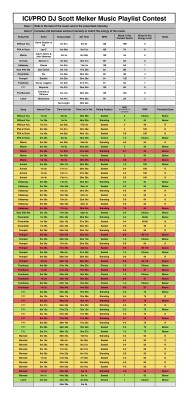
Around the same time John and Scott announced their “ICI/Pro DJ Scott Melker Music Playlist Contest” I was in a state of the dreaded “profile writers block” and I was told that a club member had commented about the lack of variety in my music. Yes, at first I was offended, but then I thought maybe the announcement of this contest and these negative comments were a sign. I decided to take on the challenge of using Scott's playlist and building the best profile I could. This project was extremely challenging for me, I'm usually a profile first music second type of class builder, this forced me to swap my way of thinking. Scott's playlist included some songs that I never imagined playing in an indoor cycling class, when I first heard them I immediately put them in the song category of “will not work in a class”, but I was being forced to use them so I had to figure out how to make them work. After countless hours of listening to Scott's playlist and tweaking my profile, I believe I have come up with a class that uses the artistry and energy of a playlist put together by one of the world's top DJs, while staying true to my scientifically proven teaching methods.
I hope you find this class profile both fun and effective, my class sure did.
I challenge you to step out of your comfort zone and create your own profile for this contest.
Scott Melker's Playlist, to download Right Click > Save As / Save Target As to download. Open in iTunes and then you'll see this in your Spotify Local File folder.
Last year I had the pleasure of interviewing Michael Sadvec, co-owner of Fit On Indoor Cycling Studio located in Manhattan Beach, CA. Michael shared with us his plans for their upcoming Tour de Pier, which was a big success!
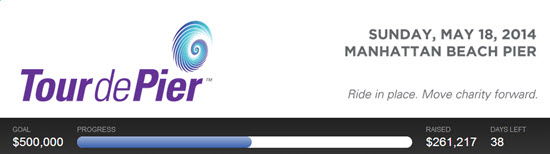
Tour de Pier is back again this year and Michael sent me a note asking for my help promoting the event. They're planning to raise a half million dollars to be distributed to the; Hirshberg Foundation for Pancreatic Cancer Research (pancreatic.org), The LiveSTRONG Foundation (livestrong.org) and Cancer Support Community (cancersupportredondobeach.org)
John,
I hope all is well!
Tour De Pier is right around the corner… May 18th! This year we should smash our $350.000 mark and are already at $256.000 with over a month to go. Goal is $500,000.00 (http://www.tourdepier.com/faf/home/default.asp?ievent=1086425) Mad Dogg Athletics is donating all of the bikes this year and we should be close to 300 or more. Would love it if you could give us a shout out.
This year they are partnering with a SoulCycle studio located in Greenwich, CT – where I see they've already sold out all of their available bikes 🙂 There are still spots open for the Mahatten Beach event – more info here.
You can learn more about Tour de Pier and possibly pick up a few ideas you could apply to hosting a charity ride of your own, by listening to this podcast
About 10 days after hitting a SoulCycle class on a recent day off, Barry’s Bootcamp owner Joey Gonzalez got a phone call. It was a lawyer for the mega-popular cycling brand issuing a message: don’t come back.
“He essentially said we have a policy at SoulCycle where instructors at other group fitness studios are not allowed to take class,” Gonzalez says. “He seemed half embarrassed.” We reached out to SoulCycle’s public relations team for comment on the policy but did not hear back.
Gonzalez took to Facebook with the news, and his post went viral. (At time of this writing, it had 158 comments and 14 shares.) Other popular fitness instructors, like Natalie Uhling, Darryl Gaines, and Lindsey Clayton weighed in to say the same thing had happened to them. Flywheel instructors jumped in to invite trainers from other studios to come take their classes (“#team”), and tons of people weighed in to rail against the lack of “soul” the policy stood for.
Then I dug in to this story a bit more. The article references this post from rateyourburn.com addressing the same issue. They begin with listing a few reasons why it maybe OK to limit the access of Instructors from competing fitness clubs. I see it as incomplete… in fact, I feel they are missing the real concerns of Soul Cycle completely.
IS IT OKAY FOR FITNESS STUDIOS TO BAN INSTRUCTORS WHO WORK FOR THE COMPETITION?
Why do studios ban instructors employed by competitors?
Trade secrets. We suppose the primary reason studios do this is to prevent competitors from coming in and spying on their ways of business, copying them or stealing their methods.
Exclusivity. Perhaps some studios want to create a country club bubble, where only approved members are allowed within their establishment.
To ward off studio-bombing. On rare occasions, people do show up just to cause trouble. In our opinion, bad behavior is the only justifiable reason to ban a paying client.
Limiting access to your “Tribe”
Paul Harmeling from Full Psycle Studio really opened my eyes about what makes Soul Cycle so successful – how good they are at cultivating a “team” or “tribe” of passionate people who are united by their participation in class. This sense of community isn't just between the customers and Soul Cycle or the Instructor. There are a lot of relationships, both personal and professional, being made between the riders.
You've probably seen this at your club. It's no secret that common interests and activities build trust between people. That trust can lead to relationships that extend beyond the club. Over the years my family and I have chosen to do business with people we've gotten to know at our club;
Claudia is Amy and my financial planner – she's also been a longtime regular in our classes.
Amy first met Craig at the club. He later hired her and we've been friends of Craig and his wife Julie for 15 years.
Morry (another regular) arranged for daughter Abby's interview, which resulted in her current job.
Richard is an Instructor at our club. He's also a C level employee at a company where younger daughter Carly would like to have a summer internship…
I can easily understand why Soul Cycle (or your club for that mater) would want to limit access to their Tribe of passionate, fitness minded people who have the financial wherewithal to pay for premium classes.
Wouldn't these same people be prospective customers for any fitness business – especially a competitor located near by?
Soul Cycle's “Tribe” is really their brand, the “special sauce” that makes them unique and profitable. Using attorneys to protect a brand from competitors isn't really any different from how Mad Dogg Athletic will do the same thing to protect the Spinning® brand from improper use.
I don't know anymore than what's been written, but I would venture this guess; Soul Cycle was concerned that Mr. Gonzalez was recruiting customers for his boot camp business. Neither of the articles, nor the Facebook post, explains how Soul Cycle's attorney would know Gonzalez was an Instructor… unless someone (maybe a class participant?) informed management.
With 40°f and rain scheduled for this past Sunday, I agreed to sub the 9:00am Cycle Sculpt class at the Life Time Fitness where I have scheduled classes. This was my third chance to teach this LTF branded format that combines Indoor Cycling and Resistance training. You can read about my earlier experiences here and here – both links include my class profile and Spotify playlist.
I was chatting with my friend Richard in the locker room before class. He has taken my cycling classes for years and he's front & center for this class religiously. He also knows something about training physically and mentally – Richard's a triathlete and Tae Kwon Do Grand Master with 9th Degree Black Belt. I told him how I rarely feel anxious before any class, but these cycle sculpt classes always make nervous.
Do you have any suggestions? I asked.
Just relax and do what YOU normally do…
Just relax?That's it? That's your suggestion?
Richard went on to explain; I haven't seen the John I know up on that bike, the other times you've lead this class. You need to lighten up man and just be you. Show us that you're having fun, work us hard and we'll all be happy!
Truer words were never spoken
As soon as Richard finished speaking I knew exactly what was wrong. Two things actually:[wlm_private ‘PRO-Platinum|PRO-Monthly|PRO-Gratis|PRO-Seasonal|Platinum-trial|Monthly-trial|PRO-Military|30-Days-of-PRO|90 Day PRO|Stages-Instructor|Schwinn-Instructor|Instructor-Bonus|28 Day Challenge']
I was trying too hard to make everything fit together. I had decided that the music, movements and transitions all had to flow together perfectly = the anxiety I felt before and during the class. I can remember panicking early in the last class I subbed when I heard the currently playing song crossfading to the next > Crap – they're not done with their exercise yet! This messed up my perfectly choreographed class and shortened the time available (and needed) for next activity… everything snowballed downward from there.
I wanted (needed?) everyone to like me and my class. I've been at this game for a long time and normally feel very confident subbing any class. Why, all of a sudden, am I now feeling insecure and looking for approval? Because these people don't normally come to my class. That's why. I realized that I was trying to be someone different in order to appeal to a group of people whom I assumed don't come to my other classes because they don't like me.
Separating their like/dislike of ME from a like/dislike of MY CLASS
After 9 years at LTF, I'm well known as the Instructor who teaches a very cycling specific class. Believe it or not, there are a lot of members who don't like that format. That's why they don't come. It isn't that they don't like ME, just my heavy emphasis on outdoor cycling. So after 30 seconds of self-talk while I walked to the studio, I had a new perspective – the proper perspective to lead the class confidently and it appeared that most participants enjoyed it 🙂
End note:After the class I was told by a member how she appreciated that I included the weight segments. She explained that a previous sub had refused to offer anything but cycling > which confirmed my new perspective (it's not ME they dislike) and I felt awesome knowing that I delivered a class very close to what these participants came for!
Evolution Cycle/Sculpt Profile #3
To keep this class more familiar to me, I switched my plan and followed our typical Evolution Cycling format through the first four tracks.
Equipment: Everyone needs hand weights = 12/15 Reps to failure and a floor mat.
This light between us 5:09 Warm up where we transition to a standing run after just a few minutes. Every minute after we sit, increase a few gears and then up again. NOTE: Cycle Sculpt includes a lot of standing work & jumps. Frequent variation is important = if you feel you've been doing something for too long, you probably have and need to change.
Revolution 5:09 Openers– I like to have everyone find a comfortable cadence and add load until they feel the need to stand. Each of 4 openers is a standing acceleration that's maintained for a progressively longer effort. Start with 15 seconds and add ten seconds each time. The goal is to get to threshold by the end of the last 45 sec effort.
Daybreak 5:04 Best Effort– This track has a long intro that lights off at exactly 1:00. I used that as a recovery after the openers. Sunday we recorded our Best Effort distance over three minutes. This is all out, absolute maximum sustainable power, from start to finish.
Remind everyone to remember both their miles traveled and Avg. Watts (if you have them) or average HR at the end. We'll be referencing these metrics later.
Runaway Baby 2:28 Reset – Resets are a short transition song, part recovery part just plain fun! Here I offer an option to either recover completely, or find a productive effort around VT1 – edge between Zone 2 & 3 in a five zone system.
Tribal Force 8:01 Floor set #1 – With only 12 participants, we had plenty of room in the front for everyone to have a mat. While standing we did: 10 x DB curls, 10 x DB OH press, 10 Pushups and 10 situps/crunch > repeat. These are all at self directed tempo and with 8 minutes there's plenty of time.
The few who choose to stay in saddle were instructed to find a comfortable climb and alternate seated and standing at their discretion.
Spectrum 5:01 Jumps on a climb – @62 RPM, this track has a very strong beat begins around the one minute mark. Use the intro to get everyone back on and settled, then build the hill – again to that point where they feel the need to stand. Follow the phrasing of the music first at 8 count, then 4 count jumps. It's super important that you can properly demonstrate these jumps exactly with the music. I'll start by calling out the count; up, two,three,four, down, two three four (or out to eight). Then get quiet and just watch them, watching you. If you see some struggling, go back to the basics of seated pedaling to the music. Rinse & repeat.
Until we go down 4:12 Floor set #2 Compound movements: 20 Squats/OH press and then alternating leg lunges with curls – 8 each leg.
Animals 5:04 Pick your head up – You're off the back! – this seated climb replicates the panic you feel when riding in a group, with your head down… only to raise it up and see you've slipped off the back. Have your riders find the 64 RPM pedal speed and then add the hill that has them thinking they should stand. There are a number of changes in the music (a great one at 1:50) that become your trigger to pick your head up, realise what's happened and then stand, accelerate and sustain the effort to fight to get back on. You'll find natural breaks that will have these efforts ~ 30 seconds. Perfect for a few brief trips to threshold.
Police and Thieves 6:10 Floor set #3 Floor work 2 sets of 20 pushups (using weights as support) and 20 crunch/sit-up.
Riders are following the 77 RPM cadence with a strong endurance (just below threshold) Time Trial pace.
Show Me 3:28 Reset Easy pace, taking time to drink, towel off and prepare mentally for the last hard effort of the class.
Ready to go 5:01 Big finish Time to replicate that earlier Best Effort – or better it if possible. This track as a nice, 30 sec building into where you'll be encouraging everyone to get back to their previously remembered watts or HR. Hit the stage button and see how far you can get over the next three minutes… or sustain that VT2 threshold HR over the timed section. [/wlm_private]
It's the end of the world 4:07 Warm down – my preference is to give athletes a chance to warm down = a gradual recovery vs. just soft pedalling. The cadence of ITEOTWAWKI is a tick over 100 RPM. Get there and then add enough resistance to keep yourself aerobic (around VT1) for the first three minutes and then slowly dial it back until everyone is conversational > that's your cue as the Instructor that everyone has recovered 🙂
Boomer Rose is a BeatBoss & Schwinn® trained indoor cycling instructor with an AMAZING story. From the moment he first clipped in, Boomer knew his life changed. The ambience, atmosphere, and camaraderie of indoor cycling introduced the fact that a healthy high does exist. If you were to ask Boomer, he'll tell you it's hard to believe or even imagine the life from which he came. Here's WHY…
Boomer used to weigh over 300 pounds. He had a history of drug/alcohol abuse, homelessness, had been to jail twice, and had never held a real job. But … that was then and this is now … today, Boomer is a full time Crunch Fitness employee and teaches 3-8 cycle classes a week. He is adulting on the daily, has formed healthy relationships, and is an inspiration to anyone who struggles with anything. Most importantly, Boomer is happy, healthy, and strong!!! Indoor Cycling literally changed his life. Watch and listen as Boomer tells a little bit of his story here …….
Tonight, Boomer teaches a special and sold out indoor cycling class celebrating his 2 year milestone and it's going to be LIT!!! RockOn, Boomer Rose … ROCK ON!!!