By Jennifer Lintz, Registered Dietitian and ICI/PRO Member Soigneur
Recently, I had the opportunity to attend a Schwinn training led by the very talented, energetic, and inspiring Julz Arney.
The training was called “All the Right CUES” and boy, oh boy did I walk away with a ton of great information. Julz gave us awesome examples of effective coaching strategies to use on the instructor bike. Interestingly, one of the points that stuck with me the most from this session had nothing to do with talking and everything to do with keeping my mouth shut.
To start the conversation, Julz asked “How many of you would consider yourselves extroverts?” and “How many of you would say you are introverts? For the most part, the group was mixed, with slightly fewer extroverts.
She then told us about a time she attended a cycle class where the instructor narrated every single minute. Participants were told what to think virtually non-stop, from warm up through cool down. For some students – extroverts, in particular – she explained, this type of teaching technique might be ideal, but it wasn't for her. For introverts, she said, some of the most interesting moments happen during the quiet, when there is time to process, reflect, and think.
Even though we all want riders to have a positive experience, I doubt any of us plans to poll the room before class to ask: “How many of you are extroverts?” or “Where are my introverts?” No way! A better approach would be to assume there is a mixture in the room. In other words, expect to have some extroverts who love it when you spend time talking, and also plan to have introverts who appreciate it when you give them a chance to hear their own thoughts.
The take away from Julz Arney's message, at least for me, was that I do not have to fill every single second of class with my voice.
She suggested having a “minute of silence” at least six times in an hour-long class.
In other words: I (and you) have the right to remain silent!
Coincidentally, after the Schwinn workshop, I viewed a recording of one of my classes from earlier this year (we are required to do this annually where I teach). As I watched, I waited and waited and WAITED for a “minute of silence,” hoping that I might already be on the right track, but it never came. As I told my supervisor afterward, I would have been so annoyed if I were a participant in my own class that day. I talked the ENTIRE time!
Since listening to Julz and watching that video of myself teaching, I have learned that great coaches need not talk non-stop, and that a blend of talking and being quiet can be a beautiful thing. Am I meeting the goal of having a minute of silence six times in every class? Not quite. But, I am definitely working on it.
NOTE: this was a previous review from 2013 that continues to remain accurate when applied to any of the magnetic friction Indoor Cycles available today.
Many Indoor Cycle manufacturers claim a connection with cycling outdoors:
100% Authentic – Spinning is authentic. It’s true to its cycling roots, yet refined to a simplicity that makes it the perfect program for any age or ability.
FreeMotion says; Drive System Mimics Outdoor Riding
The Schwinn® Authentic Cyclingâ„¢ Series is based on one simple principle: we believe that riding a bike indoors should feel as much like riding an outdoor bike as possible.
There are of course multiple similarities between riding indoors vs riding outdoors. Beyond the obvious differences, not needing to balance an indoor cycle for one, the claimed connection is that their Indoor Cycle feels like riding a bicycle outdoors.
But what does that mean? A feeling can be pretty subjective after all.
My review of the new Spinner® Blade Ion included a comment that I was a little disappointed that Star Trac continued with a friction resistance system, vs. the magnetic systems used by FreeMotion, Schwinn and Keiser.
I also teased you at the end of the post with:
Later that morning I also tried a little experiment that I’ve wanted to do for years…
What happens to your Power / Wattage when you accelerate from a set point, say; 100 watts @ 60 rpm to 90 rpm on friction based system, as compared to a magnetic system? Do they react the same way?
My apologies for the delay. I'm just getting to this today.
The ” little experiment” I conducted was something that I'd wanted to confirm/quantify for years, actually since I first started teaching on a Schwinn AC in 2010.
My early experiences riding/teaching with magnetic resistance, along with a discussion I had with Keiser's President Dennis Keiser, demonstrated to me that the amount of resistance created by the magnetic (Eddy Current) resistance system increased in lock step with a faster cadence / RPM. The faster you pedaled the harder (more force required) it was to turn the pedals.
Which is pretty much what you experience riding a bicycle outdoors, at speeds over 18mph. As you pedal faster (assuming you stay in the same gear) you and the bike move faster through the air. The faster you go, the more the resistance from the air pushes against you, making it harder and harder to turn the pedals.
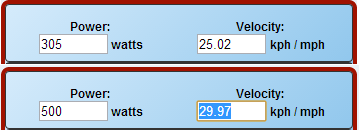
There's a handy calculator to compute the amount of work it takes to overcome the resistance of the air here.
The difference in power needed to ride 25 mph vs 30 mph
So it takes apx. 300 watts to ride at 25 mph. To ride at 30 mph (just a 20% increase) you need to create over 60% more power. You can't make the power with additional leg speed – you're probably near your maximum efficient cadence already at 25 mph. To get to 30 mph you'll need to shift to a lower gear and push harder… A LOT HARDER!
Very different from the conventional friction system on an NXT – which (to me) feels like it gets easier to pedal, the faster I pedaled. In fact most of us can take what is a high level of load (at a slow cadence) and accelerate to the point where our legs spin-out and won't move any faster.
Side note: It's extremely rare to see someone riding with excessively high cadence on a magnetic resistance indoor cycle.
I've discussed this concept here in the past, but I couldn't prove or demonstrate it. I even went so far as contacting LOOK and Garmin to see if they would lend me a set of those new pedals with the built in power meter. They wouldn't and the crank arm from my FreeMotion doesn't fit on a NXT. It remained a mystery until now.
So while I was at the IHRSA convention, I finally had the chance to compare the new Blade Ion and the FreeMotion. With both cycles offering “measured power” I felt it would be a fair comparison; Magnetic vs Friction Resistance. Which best replicates riding outdoors?
Although I wasn't exactly “scientific” in my test protocol, nonetheless the results were very interesting.
Fun with graphs!
Here's what I did
My test was admittedly simple. After completing an early AM ride with Josh Taylor, I spent some time riding both the Spinner Blade Ion and FreeMotion S11.9. I began by establishing a steady 60 rpm cadence. Then I added resistance until the power meter showed 100 watts @ the 60 rpm. Then I accelerated to (and sustained) 90 rpm and took notes on what happened. I rode both cycles twice and the results were consistent. The blue Magnetic Watts line is more squiggly than the red Friction Watts line because I used the actual date set I downloaded directly from the FreeMotion's USB port.
I'd already tested the FreeMotion S11.9, so I knew that the 50% increase in cadence would result in a doubling of power. Perfectly consistent with my understanding of how Eddy Currents increase linearly with speed. A 50% increase in RPM = a 50% increase in resistance. Although math isn't my strong suit, it's easy to see how a 50% increase in Speed multiplied by a 50% increase in the amount of force required to turn the pedals = a 100% doubling in power/wattage. While not the same effect as what you'll find chasing down a breakaway at 27 mph, it is enough to force your students to work hard in a way that will help prepare them to hang with the “A” group.
The Spinner Blade Ion reflects the inherent weakness of using a friction pad with a heavy, perimeter weighted flywheel. The graph above clearly shows how the amount of resistance doesn't increase with additional speed – it actually goes down, validating what I had hoped to demonstrate. If it just stayed the same I should have observed 150 watts @ 90 rpm, I only saw 135 watts. So where did the other 15 watts disappear to? That's a math thing I'll leave to others smarter than me to answer. I will offer a guess that if I had continued on to 120 rpm, I would have seen a progressively lower increase in wattage vs what would be expected from a doubling of speed.
So what's this all mean?
Short answer – it's my opinion that magnetic resistance is superior in every way to a friction system. Besides being zero maintenance, the linear increase in resistance is much closer to what your participants will experience outdoors. Combined with the reduced inertia of the aluminum flywheel, magnetic cycles require more work to ride and force everyone to develop better pedaling technique. IMO the net results is that the members of your club or studio will (if they take advantage of it and you coach them properly) receive a more effective workout, that will translate to them becoming stronger outdoor cyclists.
So does that mean you wouldn't recomend the Spinner Blade Ion?
Not at all… it's an awesome cycle and that battery charger rocks. The purpose of this article was to demonstrate the differences so you can make an informed decision on your own. Besides, if you're a Spinning® studio, what other choice do you have?
P.S. If you're going to be at WSSC – I'd love for you to try and replicate my test on a Blade Ion for yourself. Then report back with what you find 🙂
Many (if not most of us) were taught some variation of; “scrape gum off the bottom of your shoe” and “try to push over the top” as the “proper” way to describe how to pedal like a “real” cyclist. But is that correct? If we really want our participants to pedal like a cyclist, is this the best way to cue proper/efficient pedaling technique?
My recently completed professional bicycle-fitting with Chris Balser the Bike Fit Guru says not necessarily.
I spent about two hours actually riding my VeloVie bicycle on a computrainer during my fitting. Not continuously and never at anything beyond a JRA level of effort. Early in the process Chris asked me; “where did you learn how to pedal?” Thinking that with way over 15,000 miles pedaling a bicycle, I've gotten to be a pretty good pedaler. So like most proud people I got defensive at his suggestion. Chris must of noticed it on my face because he quickly added; you're very smooth… but your ankle is all locked up. You are missing out on a bunch of power that's available if you'd #1) unlock your ankles and #2) focus on moving your knees through the greatest range of movement possible.
USA vs. EU pedaling techniques
To demonstrate what he was talking about he had me watch myself pedaling in a mirror from the side. My years of concentration on pushing over the top and scraping across the bottom showed Chris' observation was correct – I am smooth but my ankles were nearly locked solid with my foot at a right angle to my lower leg. That, he explained, was how people in the USA pedal.
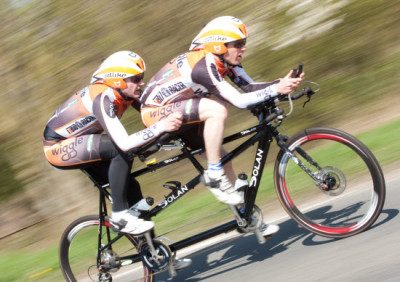
Then he showed me a number of pictures of professional cyclists like this one of a very fast tandem team from the UK:
From http://magazine.bikeradar.com
Notice how high this captain's heel is as it crosses over the top? The idea here is that by allowing the ankle to flex and the heel to rise, you create a longer lever. Longer levers create more leverage and the force can begin earlier in the down stroke = more power. When you watch a cyclist using this technique, you'll see what Chris called “big knees” – the riders knees move in a very large plane up and down. It isn't just that their legs are long or that they're riding with long cranks. The exaggerated movement of their knees comes from the additional rage of motion allowed by the flexion of their ankles.
In this video, Joe Friel demonstrates the USA focus on “push over the top and scrap across the bottom.”
Former UK professional cyclist Rebecca Ramsay runs EasyCycling.com and her video below is an excellent example of what Chris describes as the EU pedaling technique. A closeup view of this technique in slow motion begins at the 2:00 mark. Notice how much flexion she has in her ankle as it crosses the bottom. Yes she cues the “scrape across the bottom” but no push across the top. With your heel elevated there's really no way to “push” forward… just down in a strong, fluid motion that I'm learning can create some much needed, additional power from my 52 year old legs 🙂
So who's right? Good question… but I'm not sure it's the right question.
A better question would be; which way of cuing, USA or EU, will be easier to understand by our students? Or would a combination / hybrid be helpful?
I've got two assignments for you to compete and report back:
#1 – Next time you're on a bike give this a try. Concentrate on what Rebecca cues as “a flick of the ankle” at the bottom. You may feel your calf contract slightly which you'll see in the video.
#2 – Watch a stage of the Tour De France. Pay attention to the vertical movement of the rider's knees and then let us know what you find.
Instructor Kathy Palkaninec contributes The Vicious Cycle, her Audio PROfile which was one of the winners of our Ultimate Instructor Class Profile contest.
Kathy teaches at MindBody Trendzin Cooper City, FL and she begins her profile like this:
Objectives and Interests:
This ride was created after researching metabolic conditioning sequence and how to burn stubborn body fat. I found the Ultimate Cardio Sequence by Shaun Hadsall. His explanation and sequence based on science inspired my “vicious cycle”. The name of the game is Intensity first. The protocol of this ride is based on the following: Once the heart rate is elevated in the warm up, the training goes into the “fight or flight” mode with short intense bursts over and over.
The Catecholamines are the hormones released by the adrenal glands in response to stress. Being part of the sympathetic nervous system they force the release of free fatty acids into the blood stream. These short bursts will create the famous” after burn” that can potentially increase metabolic rate up to 48 hours after exercise. Science has proven that free fatty acids do pour into the bloodstream after such high intensity training. However, research shows that these fatty acids, if not removed from the blood stream, will move to another place in the body and again re-store as fat.